


Hi, I am Anguzu, Radio Pacis AI Assistant. How can I help you today? Ask me about Radio Pacis, our programmes, frequencies, news, Arua, or the world around us.
23 March 2026 · Radio Pacis Newsroom
A nursing officer screens a child for malnutrition using a middle upper arm tape during the launch in Kiryandongo district. Photos/ Sylvia Namagembe DAILY MONITOR The Ministry of Health has launched a nationwide door-to-door screening campaign to track down th
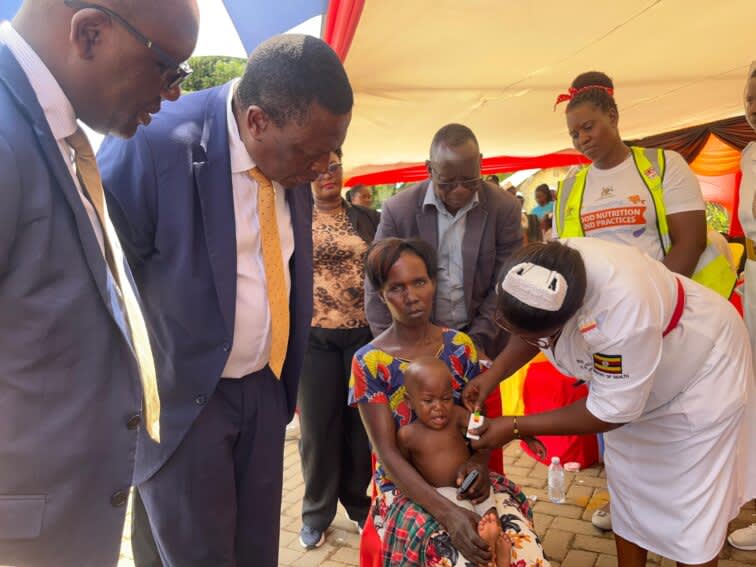
A nursing officer screens a child for malnutrition using a middle upper arm tape during the launch in Kiryandongo district. Photos/ Sylvia Namagembe
DAILY MONITOR
The Ministry of Health has launched a nationwide door-to-door screening campaign to track down thousands of malnourished children, as cases surge across the country, particularly in refugee settlements and hosting districts.
The intervention, backed by $5.4 million (about Shs19 billion) funding from UNICEF and UNHRC, aims to identify and treat at least 20,000 children suffering from acute malnutrition through mass community outreach across 13 refugee hosting districts.
Dr Samali Namukose, the assistant Commissioner for the Nutrition division at the Ministry of Health, said the campaign is a life-saving emergency response to rising cases, with health teams moving to individual households and camps to detect affected children early.
“We are going from house to house, screening for malnutrition, identifying those affected and referring them to health facilities for treatment. The approach is intended to close gaps in detection, especially in refugee and host districts affected by food insecurity,” Dr Namukose said.
She added: “Using Mid-Upper Arm Circumference (MUAC) tapes, helps VHTs to assess nutritional status by measuring the circumference of a child’s upper arm which gives a quick indication of malnutrition. At the facilities, their weight and height are measured for a more detailed assessment, which guides appropriate treatment.”
Dr Namukose warned that the situation remains critical, noting that only 48 percent of severely malnourished children currently access treatment nationwide, leaving thousands at risk.
According to official data, Uganda hosts one of the largest refugee populations in the world, with about 1,961,518 registered refugees settled in districts including Adjumani, Terego, Obongi, Madi-Okollo, Koboko, Yumbe, Kamwenge, Kyegegwa, Isingiro, Kikuube and Kiryandongo.
Under the campaign, Village Health Teams (VHTs) are conducting household assessments and referring identified children for immediate treatment at facilities equipped with therapeutic foods and nutrition supplies.
The intervention also includes treatment using ready-to-use therapeutic foods and specialised formulas for severe cases, alongside services such as immunisation, vitamin A supplementation, and deworming.
According to the 2022 Uganda demographic health survey on nutrition, the country is grappling with more than 2.4 million children suffering from chronic under-nutrition (stunting) in children under five, with levels at 26 percent, while 4 percent of under 5 are wasted (acute malnutrition).
At the launch of the campaign in Kiryandongo district, Dr Charles Olaro, the Director General of health services, said early detection is critical in preventing severe illness and deaths among children.
He added that the exercise will be supported by digital data collection, with health workers equipped with tablets to improve real-time tracking, planning and response.
“Children who suffer from severe wasting are at a much higher risk of illness and death if they do not receive timely services. Vulnerable households must not be left out and after screening, the results will be monitored using tablets that will be given to various health facilities,” Dr Olaro said.
He noted that malnutrition is often an underlying condition in many paediatric admissions, making community-level screening essential to detect cases before they worsen.