


Hi, I am Anguzu, Radio Pacis AI Assistant. How can I help you today? Ask me about Radio Pacis, our programmes, frequencies, news, Arua, or the world around us.
24 March 2026 · Radio Pacis Newsroom
Leaders take part in a team-building game promoting unity and collective action. By Proscovia Achomo Gulu City Leaders from the Acholi sub-region have been urged to strengthen unity as part of efforts to accelerate socio-economic transformation in Northern Uga
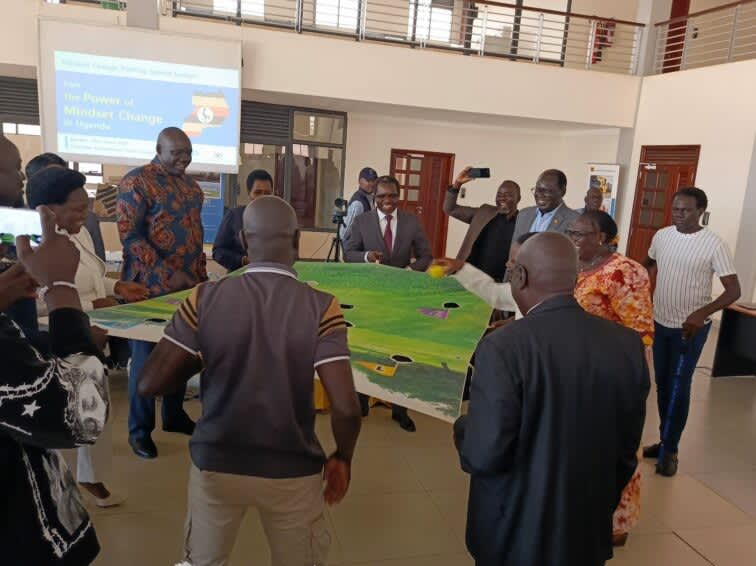
Leaders take part in a team-building game promoting unity and collective action.
By Proscovia Achomo
Gulu City
Leaders from the Acholi sub-region have been urged to strengthen unity as part of efforts to accelerate socio-economic transformation in Northern Uganda.
The call was made during a leadership training at Gulu Logistics Hub, that brought together Members of Parliament–elect, LC5 chairpersons, and other regional leaders to discuss strategies for unlocking the region’s economic potential and improving livelihoods.
Speaking at the engagement, the Minister for Northern Uganda, Kenneth Omona, emphasized that the progress of the Acholi sub-region depends on leaders working together regardless of political affiliation.
“Acholi can only transform when its leaders work together with a common purpose. Development does not follow political parties—it follows unity, planning, and commitment to the people we serve,” Omona said.
He also raised concerns about divisions within the Acholi Parliamentary Group, noting that the internal disorganization sometimes creates confusion even for government officials seeking to engage the legislators.
“Sometimes the Acholi Parliamentary Group appears divided, and at times it becomes confusing to know which team to work with because they are not speaking with one voice,” he added.
The Woman Member of Parliament for Agago District and minister the state minister for Economic Monitoring in the Office of the President, Beatrice Akello Akori, echoed the call for unity, noting that divisions among leaders have for years slowed development in the region.
“I have been hearing many local artistes singing about the Acholi Agenda. When I joined politics and began to follow the so-called agenda, I did not find anything tangible,” Akello said. “It is not easy to bring the Acholi people together, and this has been failing us for a long time. I pray that these demons of division among Acholi should be defeated so that we unite for the sake of our motherland.”
Similarly, the Minister for Relief, Disaster Preparedness and Refugees, Hilary Onek, who also represents Lamwo County in Parliament, urged leaders to focus on initiatives that directly improve the livelihoods of the people.
“Our mission as leaders must be clear—improving the livelihoods of our people. When leaders unite around that mission, we can transform agriculture, create jobs, and bring real development to the Acholi sub-region,” Onek said.
The leadership training was organized by Operation Wealth Creation under the framework of the Acholi Investment Forum, bringing together political and administrative leaders to discuss strategic priorities for unlocking the region’s economic potential.
Bishop Emeritus of Northern Uganda Diocese, Nelson Onono Onweng, warned that fragmented leadership is weakening the region’s ability to rebuild and prosper.
According to the bishop, one of the major challenges facing Acholi today is that many individuals claim to speak on behalf of the community while working in isolation.
“Acholi today has what I would call dead leadership because everyone thinks they speak for Acholi,” he said. “For effective leadership to emerge, our leaders must stop working alone. When leaders act individually, the power of the community becomes weak.”
He noted that in the past, Acholi was widely respected and difficult for outsiders to challenge, but that situation has changed over time due to disunity and lack of coordinated leadership.
“There was a time when Acholi could not easily be dared or touched,” the bishop said. “But today things have changed. We must rebuild our strength through unity and shared purpose.”
He urged leaders in the region to emulate the example of biblical leadership, which emphasizes humility, service, and collective responsibility for the wellbeing of the people.
“If our leaders follow the values demonstrated by biblical leaders—servant leadership, unity, and moral responsibility—Acholi can rise again,” he added. “Together we must work to rebuild our region and make Acholi prosperous once more.”
The Acholi sub-region in Northern Uganda has faced significant challenges following more than two decades of conflict involving the Lord’s Resistance Army (LRA). The war displaced large numbers of people into camps and disrupted traditional leadership systems, livelihoods, and social structures.
Although peace returned to the region around 2006, Acholi continues to deal with the long-term effects of the conflict, including poverty, youth unemployment, and weakened community institutions. Some leaders and observers say that divisions among political, cultural, and religious leaders have also slowed the region’s recovery and development.