


Hi, I am Anguzu, Radio Pacis AI Assistant. How can I help you today? Ask me about Radio Pacis, our programmes, frequencies, news, Arua, or the world around us.
26 June 2025 · Radio Pacis Newsroom
A side view of Arua Hill Stadium on the Western Side. By Dramadri Frederick Arua City The delayed completion of Arua Hill Stadium is negatively impacting talent development among school children in Arua city. Construction of the stadium, which began in 2018 un
A side view of Arua Hill Stadium on the Western Side.
By Dramadri Frederick
Arua City
The delayed completion of Arua Hill Stadium is negatively impacting talent development among school children in Arua city.
Construction of the stadium, which began in 2018 under a Public-Private Partnership (PPP) arrangement, has stalled for seven years.
The project is being handled by Development Infrastructure DI. The stadium is located along Arua-Pakwach Road on the former Arua Hill Boma ground.
Historically, this area served as a playing field for core curricular activities, including football, netball, handball, and baseball and it also functioned as a revenue-generating venue for the then Arua Municipality through events hosting, but these activities have since ceased.
Arua Hill Primary School, which relied solely on the Boma ground for its sporting activities, has been forced to train pupils on a cramped school compound as preparations for this year’s primary school ball games are underway.
Mr. Bua Tom, the school’s games teacher, describes the stadium project as a disaster for the school, explaining that, the school lacks sufficient space to host all its sporting activities, including football and netball, while also preparing for other sports such as athletics, cricket, baseball, handball, and volleyball.
“We are forced to train on the school grounds, both in front of and behind the school, but the space is inadequate. We might not even have enough room to build a netball court for the girls. There’s no open space for children to spread out; we can only conduct training once a day for an hour in the evening, which is not enough to build a strong team,” Bua said.
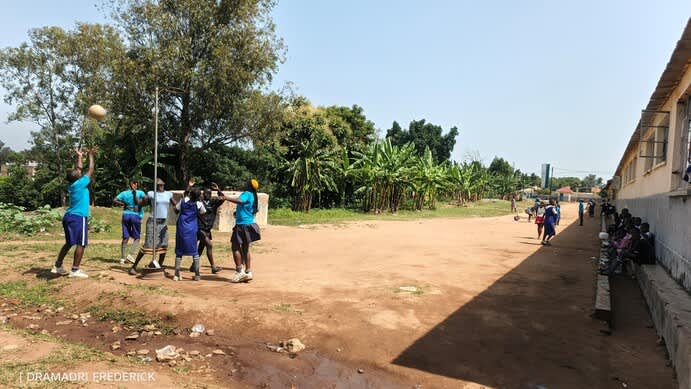
School girls practicing Netball at Arua Hill Primary School Compound.
Arua Hill Primary School has an enrolment of 2,300 pupils and receives about Shs 3 million shillings annually from the government inform of Capitation Grants under the Universal Primary Education program.
The school had hoped that once the stadium was completed, it would offer better training facilities. Unfortunately, the ongoing delays have dashed those hopes and are now taking a toll on the school’s talent development initiatives.
“As a school, we believed this project would be a blessing, providing a secure and enclosed stadium for our students’ activities. Its non-completion has become a disaster; it has squeezed us because we now lack a proper playing ground. Sometimes, snakes, foxes, and even thieves hide in the bushy areas around the site, creating dangers and causing havoc in the school,” the Sports Officer lamented.
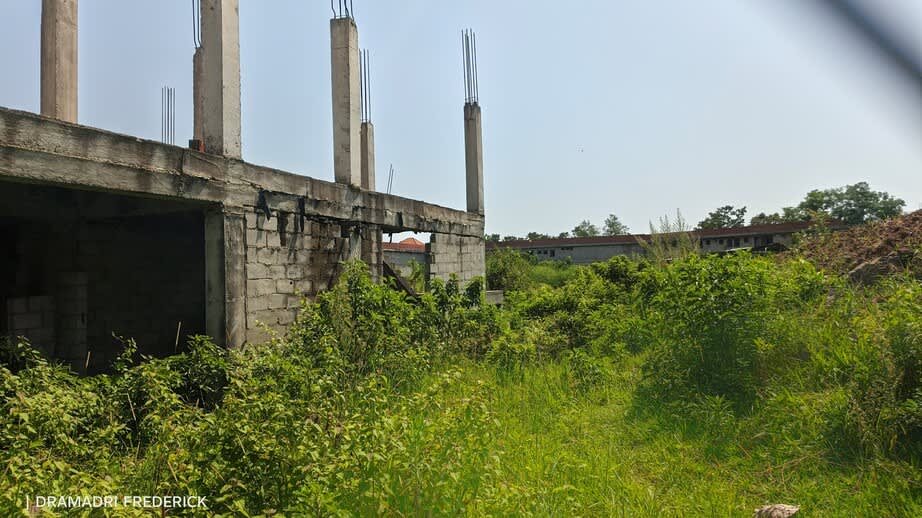
Southern end of the stadium from the School Fence.
In 2019, Arua Municipal Council handed over the 9.7-acre piece of land at Arua Hill grounds to Development Infrastructure for the construction of a 20,000-seater mini-stadium and a business park under a PPP agreement with a 49-year lease for the land signed in 2018.
However, although the project was expected to be completed in three years, work has now stalled for seven years without significant progress.
Meanwhile, city leaders withdrew supervisory support to the project, raising concerns about the quality of the eventual construction.
Godfrey Anguyo, the city councilor for Manibe and Arua, stated that the 49-year lease granted to Development Infrastructure contains several loopholes, which hinder the city council’s ability to exert pressure on the developer, noting that, the agreement did not specify a clear timeline for project completion and permitted the developer to hold a 60% share, with only 40% remitted to the council.
According to him, there is little expectation of value for money in this partnership, given the lack of enforceable measures to ensure timely and quality delivery of the project.
“I sympathize with those who have invested heavily in this project, because they are not getting value for their money. School pupils are suffering; even Arua Hill playground was once a lively Boma ground hosting many council activities. Overall, there is no value in the PPP agreement between DI and Arua Municipal Council,” he said.
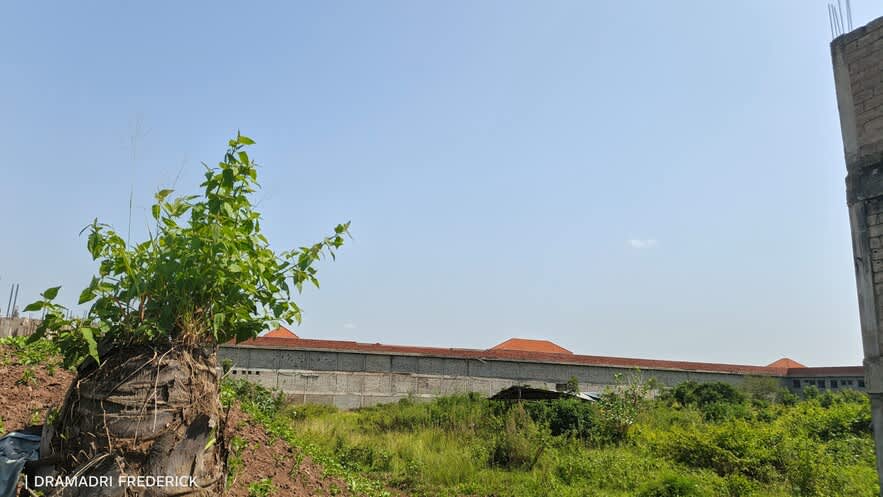
Inside the stadium.
In October 2022, during a special council engagement, Development Infrastructure’s Executive Director, Joel Aita, requested 13 months to mobilize resources and complete the remaining stadium components.
However, no activity has taken place at the site since then. Recently, in February 2024, Aita reached out to the government for a bailout, claiming that his company had gone bankrupt and that work at the stadium was only 40% complete. Government paid death ear.
When contacted, Joel Aiita, the Executive Director of Development Infrastructure, reiterated that, the company has gone bankrupt and is now seeking avenues to complete the stadium and the business complex within two years.
According to Aiita, the company advertised stalls and space in the business complex expected to be part of the stadium project as a way of raising funds. However, close to 8 billion shillings remains unpaid by some of the business persons.
He noted that since the government has failed to assist in raising funds for the project, they should not be pressured to deliver it.
“We have not borrowed any funds from the government. Instead, we seek opportunities outside the West Nile region and Uganda to secure contracts, and the funds we generate from these are invested in the stadium project. We hope that once we raise 10 billion shillings within two years, we will be able to complete the stadium,” Aiita explained.
He added that DI is in contact with those who paid to secure spaces in the facility under construction, and that a total of 8 billion shillings is still owed to the company.
Currently, construction at Arua Hill Stadium is stagnant, with overgrown bushes, incomplete walls, and partial structures, especially on the eastern and southern sides.