


Hi, I am Anguzu, Radio Pacis AI Assistant. How can I help you today? Ask me about Radio Pacis, our programmes, frequencies, news, Arua, or the world around us.
15 July 2025 · Radio Pacis Newsroom
A notice on the Gulu Regional Blood Bank Noticeboard. All photo by Desire Alimocan By Desire Alimocan and Achomo Proscovia One of the priciest commodities in the world- blood is necessary for everyone, regardless of age, education level, gender or social statu
A notice on the Gulu Regional Blood Bank Noticeboard. All photo by Desire Alimocan
By Desire Alimocan and Achomo Proscovia
One of the priciest commodities in the world- blood is necessary for everyone, regardless of age, education level, gender or social status. This complex fluid is essential for the proper functioning of the human body but unfortunately, in Acholi sub-region- like is the case in many parts of Uganda-not many patients who need it are able to access it due to the prohibitive costs.
Loud cries from helpless patients and caretakers prompted this mini survey by Radio Pacis in Gulu City, with support from the Uganda Media Women’s Association and the Finnish Foundation for Media and Development (VIKES).
Many of the victims interviewed, in Gulu city expressed dismay that blood- which is donated freely by people willing to save lives is sold so expensively that those who can’t afford, end up dying.
Since blood can only be obtained by donation, just think of how a person who willingly gives blood to save a life could feel when they find out that their blood is being sold to a patient in dire need due to an ailment.
In Uganda, sale of blood is illegal, but without an enabling law, it is difficult to regulate the service. Uganda is still among several countries without regulations covering blood transfusion services.
Commissioned in 2003, the Uganda Blood Transfusion Services (UBTS) operates under the National Health Policy which to some, does not prescribe any serious legal consequences for breach and so they continue to profit from the blood donated to save life in hospitals.
According to a victim of this unethical and illegal practice who preferred anonymity, she has bought blood twice from a reputable medical facility yet it is released free of charge from the banks.
She says, “I received blood transfusion because I used to bleed a lot after a miscarriage so I needed more blood. I was given free blood at first and then when I went back to the referral hospital after the condition persisting, I was charged. My condition was severe, so they gave me blood freely twice. Then the second time I bought as they told me the pack for children is at 7000 shillings and the one for elders is at 14000 shillings. From Gulu Referral, I bought it because I was told there was no blood and they would get it from somewhere else.”
This greed has affected some of these victims financially, and sometimes impacted their health negatively. In some cases, patients have lost lives due to anemia and negligence of these health workers.
“Buying blood can affect one mentally because you know that blood is given freely but reaching the hospital you are charged. But for my case, I looked for the money because I wanted life,” the anonymous victim says.
Another gentleman, Samuel Otema(not real name) narrates how his friend lost a child in 2019 due to their inability to obtain blood in time. He claims the hospital's medical staff indirectly demanded payment before blood could be released.
“I remember when my friend had called me that a sister's son is sick, that I should go and help, since I'm a blood donor, I showed this nurse at Lacor Hospital that this is my ID, I'm a blood donor, I have a patient here. She told me straight, “do you think this ID will help you? It will not help you.” They told me that there's no blood, and I saw other people being given blood.
At around 1 p.m., when I wanted to check on how the child was doing, because I had told the mother to keep watching the child from outside the laboratory and would call her back after taking my sample. Upon reaching there, I heard that the child passed on,” he narrates.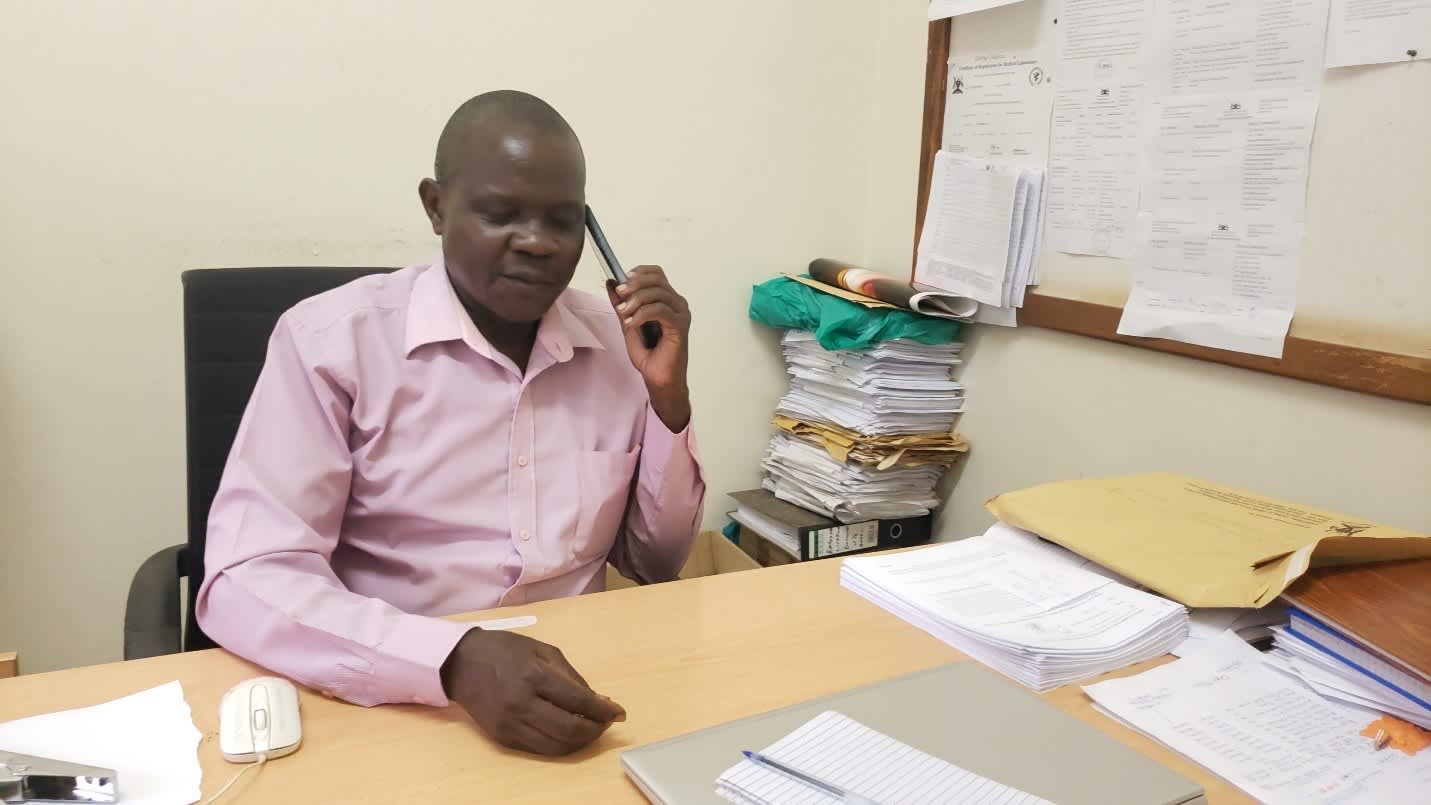
Dr. Yandua Matayo in his office.
According to Yandua Matayo, the laboratory manager and senior laboratory technologist at the Gulu Regional Referral hospital, which performs between 250 and 350 transfusions per month, there is a general blood shortage in Gulu City, where Gulu Regional Blood Bank is situated.
He however, quickly adds that while it may be true that some patients pay for blood at the facility, management does not condone this illegal practice.
“I don't know whether that issue of selling or buying blood is really genuine. Well, I wouldn't think it's a lie, it can be true. There are moments when students are on holiday. It's really hard. Sometimes we go to the regional blood bank three times in a day and you end up with like five units of blood. So, blood is not there,” Matayo explains.
Some of the people said that because of scarcity, buying of blood may provide an easy and quicker way out of this predicament. They say that scarcity of blood may also be the reason why money is being exchanged for blood. In an attempt to obtain blood that matches their type or group, some patients purchase blood indirectly.
According to one of the medical practitioners who dis internship at St. Mary's Hospital Lacor in Gulu city, patients whose blood type is uncommon are occasionally asked to find a donor whom they subsequently give money, what he refer to as appreciation but in reality, they are paying for the blood that was donated to them.
Michael Ojok, a blood donor who also assists in connecting donors with the Gulu Regional Blood Bank, elaborates saying that certain patients and their caregivers are compelled to purchase blood due to their medical conditions, which makes them anxious to obtain blood as soon as possible to prevent the patient's condition from worsening.
“I think some people see that their patients are desperate or someone wants to take advantage of them. That person may be a worker at the blood bank or at the hospital so they think after giving them money, they will get the blood very fast but that person has to follow the same process by requesting. Personally, I have never seen somebody say they have bought blood but it would be better if someone came out to testify. First of all, there is little supply of blood, so the people are desperate,” he explained.
As previously stated, selling blood to another individual is prohibited and may attract penalties.
Dr. Agasha Dorine Birungi, the Principal Medical Officer at the Gulu Regional Blood Bank, which is a division of the Uganda Blood Transfusion Services, clarified that,
“Yes, we do hear people say that they paid for blood and all of that, but as the blood bank, we want to let you know that blood is not sold at the Gulu blood bank. It's not sold at any of the blood banks in the country. Blood is not for sale. It is illegal and unethical for any health facility, any health worker, whether public or private, to charge for donated blood,” said Dr. Agasha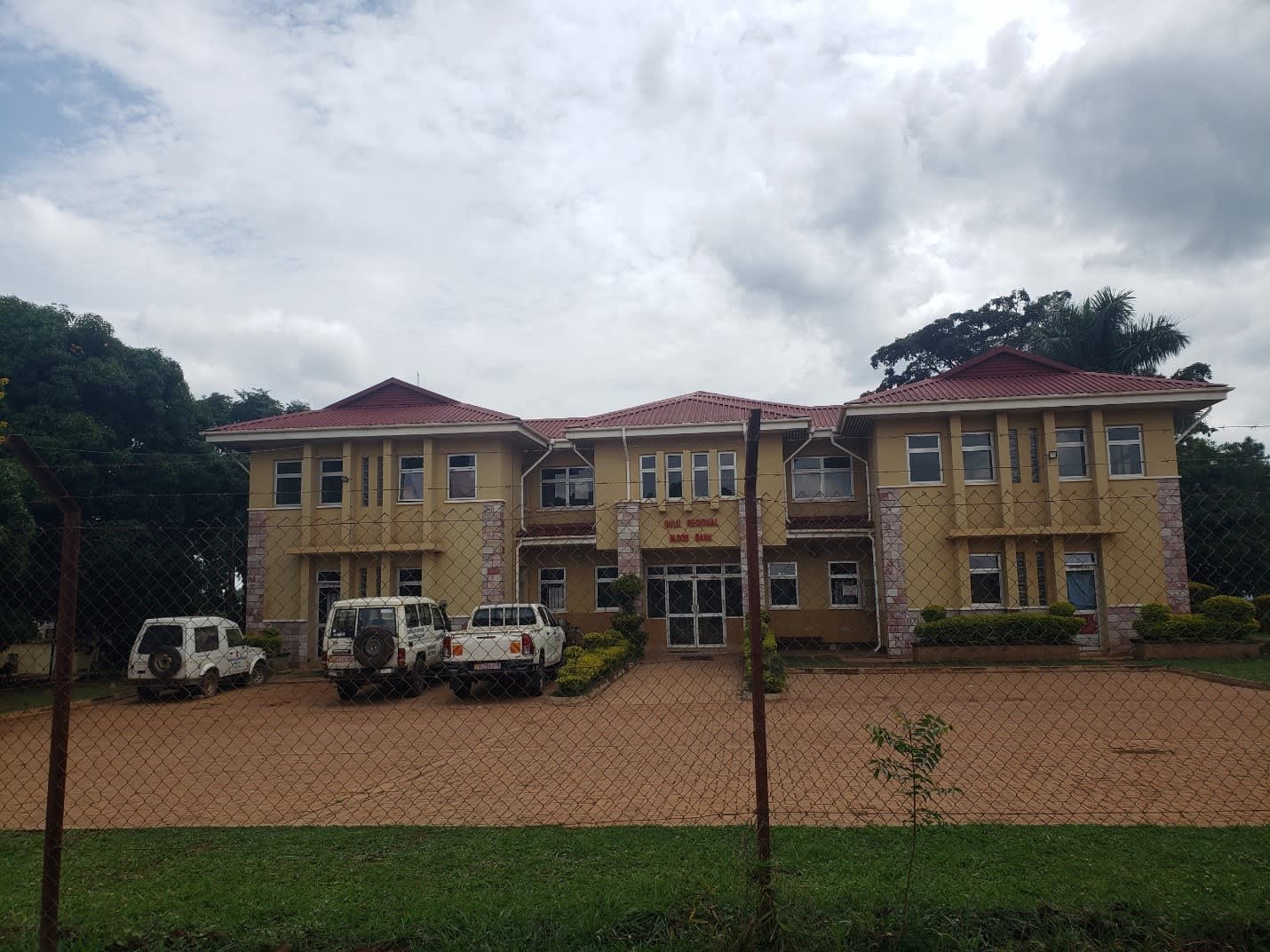
Gulu Regional Blood Bank in Gulu City.
Dr. Dorine adds that there are rare blood groups like A negative, B negative, O negative, AB negatives that may not be found among people around which prompts them to contact donors from outside Gulu City.
“So sometimes, because somebody is in an emergency, there is not a single unit of that blood group, but there is someone maybe in a kit room who has that blood group and can donate, Those situations can be very difficult. So, someone can say, but how do I travel and come now to the blood bank? It is Sunday evening, 9pm, and the blood is really needed. So, we've had challenges there. And someone can say, let me give you the transport and you come. But those are very rare situations, very rare situations,” Dr. Agasha added.
She also encouraged the community to report such practices using the Toll-Free number 0800122422, and warns the health workers to stop selling blood to patients as it is unethical and can attract punishments.
Dr. Joyce Moriku Kaduchu, the state minister for primary education and former Minister of State for Primary Health Care, confirmed that the practice is widespread throughout the country, calling on the concerned authorities to urgently end it.
“I want to say that yes, in some situations we've had some people who are really greedy of money and think every commodity is for sale. They go ahead and pick blood and sell which is not the way to go. I think we need to stop that. We're encouraging our people, those who are stealing and getting money out of selling blood, it is not allowed. God will curse you,” Dr. Kaduchu cautioned.
The senior communication officer at Ministry of Health Uganda, Emmanuel Ainebyoona encouraged patients to report such practices to relevant authority. “Blood is not for sale because people donate for free. Does anyone ask to be paid after donating? So, the same is expected of those who give it to patients. Anyone selling blood should be reported to the authorities for apprehension, they can be interdicted, they can be dismissed from being health workers,” Ainebyoona emphasized.
In order to guarantee safe and adequate supply of blood, the World Health Agency advised that blood donation and transfusions be voluntary and unpaid. The agency also wants to see 100% voluntary and unpaid blood donation worldwide.
Currently, in Uganda there is no specific legislation or regulation that governs blood donation and transfusion services which makes it difficult to apprehend culprits.
The UBTS Transfusion Services, through the ministry of health is thus actively striving to put an end to the practice by proposing legislation that will prescribe tough penalties for individuals who engage in this unlawful conduct.
According to the World Health Organization's proposal, a nation should collect blood unit equivalent to 1% of its population. The Gulu Regional Blood Bank collected 34,000 units of blood in FY2024/2025, falling short of the national blood bank's goal of 420,000 units.
Well, with all these efforts in the pipeline, it is hoped that more lives shall be saved and critically ill patients and their caregivers not only in Acholi but the entire country shall be relieved of the burden of spending money (between Shs. 7000 to shs. 20,000) on buying blood.
The production of this story was made possible through financial support from the Finnish Foundation for Media and Development (VIKES), in partnership with the Uganda Media Women’s Association (UMWA)