


Hi, I am Anguzu, Radio Pacis AI Assistant. How can I help you today? Ask me about Radio Pacis, our programmes, frequencies, news, Arua, or the world around us.
7 May 2026 · Radio Pacis Newsroom
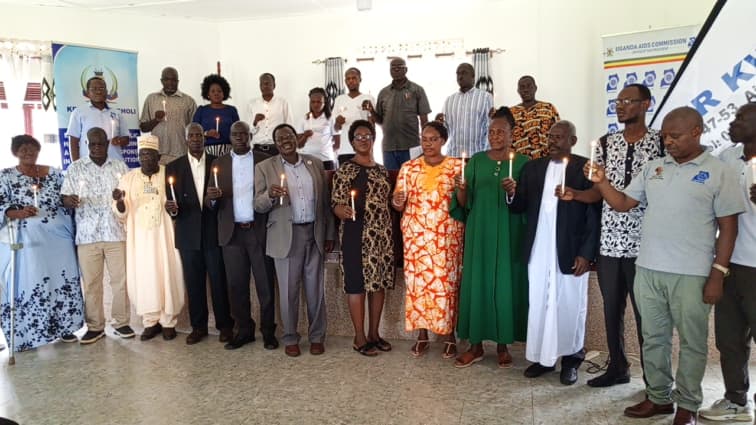
Cultural leaders, city leaders and team from Uganda Aids commission at Ker Kwaro Acholi join the rest of the world in candle lighting in the commemoration of the people who loss their lives of HIV. By Odong Stephen Gulu City Communities in the Acholi sub-regio
By Odong Stephen
Gulu City
Communities in the Acholi sub-region have been urged to abandon harmful cultural practices, particularly wife inheritance, which health experts and cultural leaders say continue to increase the risk of HIV/AIDS transmission.
Brian Masimbi, a data manager at the Uganda AIDS Commission, noted that HIV prevalence remains high across the region, with Gulu City recording the highest number of cases at 380, Nwoya follows with 280 cases, Pader with 250, and Agago with 220.
Other districts include Omoro (210 cases), Amuru (190), Kitgum (180), Gulu District (130), and Lamwo (110).
Masimbi emphasized that Gulu City also leads in new infections, recording nearly 430 cases. He called on communities to reflect critically on their traditional and behavioral practices.
“When you look at the prevalence in the Acholi sub-region, Gulu City has the highest numbers. Even in terms of new infections, it still leads,” he said.
He further urged stakeholders to integrate HIV awareness into all community activities to help reduce the rising prevalence.
Harriet Akello, Assistant Commissioner of Adult Literacy at the Ministry of Gender, Labour and Social Development, said, Ker Kwaro Acholi took a firm stand in 2013 on HIV prevention by encouraging communities to reassess cultural practices that expose people to infection.
She explained that revised cultural guidelines discourage sexual relations in widow inheritance.
“We agreed that widow inheritance should not involve sexual relations. A relative can support the family and take responsibility for the children, but without engaging in sexual relationships,” Akello said.
She added that historically, the practice contributed to HIV transmission because families often did not consider the cause of death of the deceased, resulting in widespread infections and family breakdowns.
The Deputy Mayor of Gulu City, Christine Olok, called for unity in the fight against HIV/AIDS.
“HIV/AIDS rates are increasing every day. The first step is awareness, understanding the risks and taking the disease seriously. If we join hands as leaders, parents, and community members, we can reduce these rates and protect our communities,” she said.
Rwot Mario Omal, Clan Chief of Ariya Chiefdom, acknowledged that wife inheritance remains part of Acholi tradition but stressed the need for caution.
He advised families to establish the cause of death and confirm the HIV status of those involved before proceeding.
“I do not completely disagree with the practice, but families must understand the circumstances surrounding the death. Health status and character must be considered to prevent further spread of HIV,” he said.
He also called for stronger collaboration among cultural, religious, and community leaders in combating HIV/AIDS.
Christine Olot, Deputy Minister for Gender and Culture at Ker Kwaro Acholi, warned that wife inheritance contributes not only to HIV transmission but also to gender-based violence and poverty.
“In many cases, these arrangements do not last. Some men enter them for personal gain and later abandon the families,” she said.
Okot maintained that the practice should not be encouraged within communities.
Florence Amito, the Gulu City HIV focal point person, encouraged residents to know their HIV status through regular testing.
“If you test positive, it is important to start treatment immediately. We promote a ‘test and treat’ approach, where individuals begin medication right away. Adhering to treatment instructions is essential,” she said.
The national statistics from the Uganda AIDS Commission indicate that about 1.5 million people are living with HIV in Uganda. Of these, 930,000 are women, 570,000 are men, and 71,000 are children.
This represents a national HIV prevalence rate of 4.9 percent, meaning that about 5 in every 100 people are living with HIV. Among women, the prevalence rate stands at 6.4 percent indicating that roughly 6 in every 100 women are HIV-positive while among men, it is 3.4 percent, or about 3 in every 100 men are HIV positive and this data shows that women are more affected by HIV than men in Uganda.