


Hi, I am Anguzu, Radio Pacis AI Assistant. How can I help you today? Ask me about Radio Pacis, our programmes, frequencies, news, Arua, or the world around us.
9 May 2026 · Radio Pacis Newsroom
A group of Refugees watering garden in Adjumani district west Nile region. By Inyakuni Kennedy Moyo Lack of community awareness is a primary driver of environmental degradation in Northern Uganda where high reliance on natural resources for survival often clas
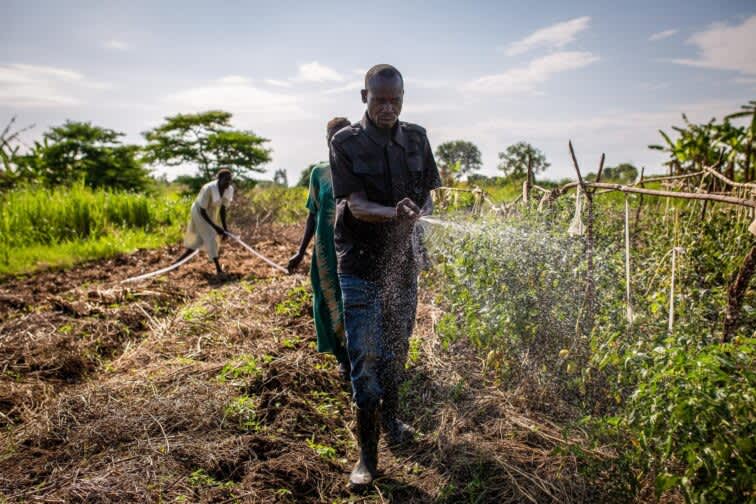
A group of Refugees watering garden in Adjumani district west Nile region.
By Inyakuni Kennedy
Moyo
Lack of community awareness is a primary driver of environmental degradation in Northern Uganda where high reliance on natural resources for survival often clashes with sustainable management.
Many communities perceive wetlands and forests primarily as sources of immediate livelihood rather than critical infrastructure for climate regulation. For instance Ignorance regarding the 100-meter buffer zone leads to farming and brick-laying in fragile areas which destroys the natural kidneys of the region, leading to water pollution and increased flash flooding, couple with the lack of awareness about the long-term impact of deforestation resulting into the rampant cutting of indigenous trees for charcoal the primary energy source in the Northern Uganda which triggers soil erosion and prolonged droughts.
Yet many farmers in the region lack the knowledge of Climate-Smart Agriculture, Soil Exhaustion leading to over-cultivation which depletes soil nutrients and reduces agricultural productivity. And Mismanagement of fertilizers and pesticides due to low literacy can pollute local water bodies, harming both biodiversity and community health.
In urbanizing areas like Arua City there is a significant gap in knowledge concerning waste sorting Where Households often dump plastics and papers directly into landfills or drainage systems because they lack skills in the “4Rs” (Refuse, Reduce, Reuse, Recycle). This contributes to urban flooding and permanent land contamination.
Historically, top-down conservation models excluded locals, leading to a who knows and who cares Attitude where communities do not feel they own local forests, Low awareness prevents women and youth who are most affected by climate change from participating in decision-making processes that could protect their environment.
To address the underlined challenges, The “Go Green” campaign by Radio Pacis has become a cornerstone of environmental advocacy in Northern Uganda evolving into a multi-dimensional platform for community-led conservation. Now in its eighth year, the campaign has moved beyond simple awareness to drive measurable ecological and social impact.
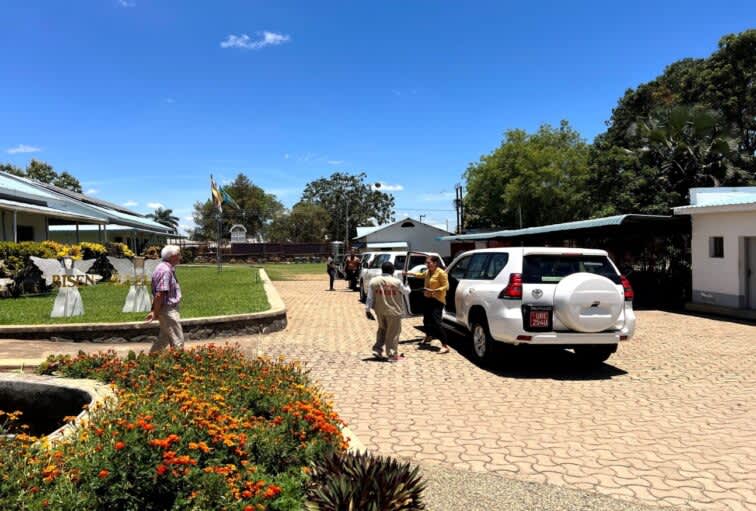
EU delegation at Radio Pacis headquarters to discuss energy issues in west Nile region.
Since its launch in 2018, the campaign has delivered over 18,000 tree seedlings annually to schools, religious institutions and individuals across the West Nile region. In the Northern Uganda Green Dialogue, Radio Pacis hosts the largest environmental forum in the region, bringing together stakeholders, government officials, and the public. These live-broadcasted dialogues focus on sensitive issues like the illegal charcoal trade and wetland encroachment.
The campaign has established plastic collection points in major urban centers, encouraging communities to view plastic as a recyclable resource rather than trash. Through its Go Green in Schools initiative and youth-targeted programs, the campaign empowers the next generation to act as environmental stewards. The Radio demonstrates sustainability through its own operations, utilizing a 300 kWp solar park (expanding to 504 kWp) that not only powers the station but also supports the Arua Regional Referral Hospital.
The 2026 campaign is particularly significant as Adjumani District hosts the national celebration for World Environment Day on June 5, 2026. Radio Pacis is leveraging this national spotlight to address critical local issues, such as the degradation of the Zoka Central Forest Reserve and the environmental impact of hosting large refugee populations.
Sensitization efforts in Northern Uganda have moved beyond just talk to yield tangible results in reforestation, clean energy, and habitat restoration. Education-focused initiatives have turned students into active conservationists. In the districts like Lira, and Arua, Youth Conservation camps have trained hundreds of students in the “4Rs” (Refuse, Reduce, Reuse, Recycle). These students now manage nurseries and school woodlots, providing both fruit for nutrition and a green canopy for their communities.
Students receiving tree seedlings for planting.
Organized community engagement has successfully reclaimed thousands of hectares of degraded land. For example restoring the West Nile Range Organizations like Nature Uganda and WCS are working with hundreds of residents in Yumbe and Terego Districts to restore degraded woodlands. Through conservation agreements, individuals receive indigenous seedlings and technical support to monitor forest growth, ensuring high survival rates for new plantations.
In the West Nile region, communities have embraced Farmer Managed Natural Regeneration {FMNR} a low-cost method of nurturing native vegetation back to health. Farmers now identify and protect regenerating tree stumps on their own land, which has proven more effective and affordable than large-scale replanting.
Policy and Legal Gaps
Even where regulations exist, such as the National environment Act, many residents are unaware of their legal rights and responsibilities. This knowledge gap makes it difficult for authorities like National Environment Management Authority {NEMA} to move from enforcement back to preventive sensitization.
Uganda’s forests have been depleted due to subsistence agriculture, charcoal production and poverty enhance need to employ local communities to plant, protect, manage, and monitor reforestation to address food security, and supporting community agroforestry to reduce pressure on existing forests.
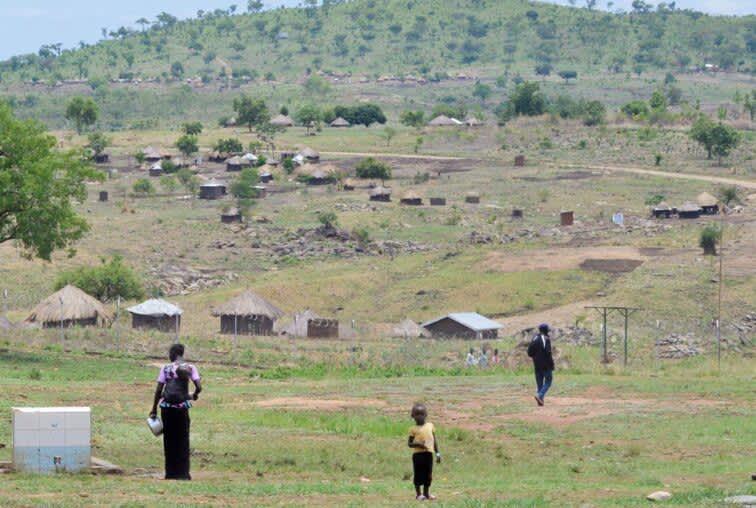
Imvepi Settlement camp in Terego District with a depleted forest cover. PHOTO/FELIX WAROM OKELLO
Uganda has lost 41.6% of its forest cover in the last 100 years (1921-2021). In 1900, Uganda’s forest cover stood at 54% and by 2017, it stood at a miserable 12.4%. There is consistent pressure on land for cultivation and settlement and increasing demand for wood fuel. While efforts have been made to restore the forest cover, the population has not been adequately involved in this restoration process.
94% of Ugandans rely on unsustainably sourced fuel wood, with gas being prohibitively expensive, the vast majority of Ugandans rely on charcoal or firewood that has been harvested from national forests or the private lands of impoverished farmers.
Actions taken by government of Uganda
Regarding the forest sector in Uganda, in the last one or so decades, Uganda has carried out several Policies, Legal and Institutional Reforms aimed at promoting the conservation and sustainable use of the country’s forest resources. The reforms include putting in place of the National Forestry Policy, 2001, Enactment of the National Forestry and Tree Planting Act 2003, the National Forestry Authority. And District Forestry Services being made. To address the question of enforcement in the forestry and other environment sub-sectors, the government also established the Environmental Protection Police Unit. Despite these interventions, the country continues to lose forest cover at a very alarming rate. The existence of forestry-related policies such as the Uganda forestry policy and the National Environment Management Policy, which was designed to protect and preserve forest ecosystems, there still exists rampant deforestation in Uganda today.
Over 80% of Uganda’s population is rural and depends on rain-fed agriculture, which is vulnerable to impacts of adverse effects of climate change. In many districts of Uganda, the declining forest cover has resulted in a fuel wood deficit hence raising costs and increasing the burden on women and children who collect firewood.
Therefore, if the situation is not reversed the knock-on effect will be catastrophic and contribute to exacerbating soil degradation, decline in food security, disease and conflict. However there is an opportunity to work with communities and landowners to turn their degraded land into productive forests that sequester carbon, grow crops in the short term, fruit in the long term, and restore microclimates.