


Hi, I am Anguzu, Radio Pacis AI Assistant. How can I help you today? Ask me about Radio Pacis, our programmes, frequencies, news, Arua, or the world around us.
30 June 2026 · Radio Pacis Newsroom
Pius Olam Executive Director City Gate Mixed Farm at his poultry which is part of the 4 four-acre model. By Alimocan Desire Gulu Launched by the president, the four-acre model has since proven to be a great idea for many farmers in Uganda who are practicing it
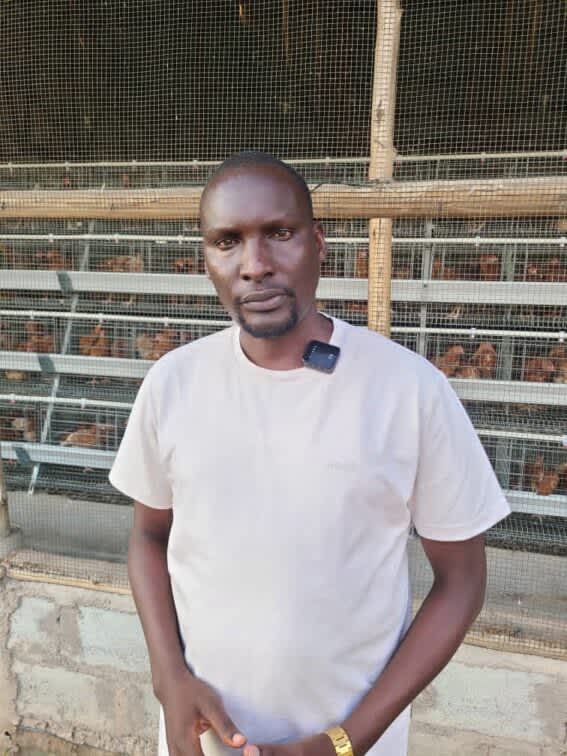
Pius Olam Executive Director City Gate Mixed Farm at his poultry which is
part of the 4 four-acre model.
By Alimocan Desire
Gulu
Launched by the president, the four-acre model has since proven to be a great idea for many farmers in Uganda who are practicing it in that it pays daily from any of the enterprises that one ventures in on the four acres of land.
His Excellence, Yoweri Kaguta Museveni invented this model to help smallholder farmers transition from subsistence farming to commercial, profit-oriented agriculture. It provides a platform for making limited land highly productive, generating steady household income, and ensuring food security.
Some farmers in Northern Uganda have taken it seriously and upon themselves to eradicate the poverty that has for long struck the region.
Pius Olam, one of the Farmers in Lango Sub-region who embraced the model, shares his success story on how this farming model has developed and is now helping him reap big from his once small project that grows every single day.
Inspired by Kawumu Presidential Farm in Nakaseke District and passion for animals and agriculture, Olam developed an idea to open up a demonstration farm back at home, which decision gave birth to City Gates Demonstration Farm in Amucha Ward, in Lira City.
“When I was taught about how an acre model farm or a four-acre model farm works, I realized it works so much. So, when you look at coffee, when you plant coffee, like let’s say like one acre of coffee on a spacing of about 10 by 10, you’ll get about 450 stems. Now, when you have the 450 stems, you find that each stem will always give you about between five to six kilos of coffee beans,” he explained.
“Now, if you sell these five kilos, always you can sell at minimum of less than about 6,000 a kilo. This is a lot of money. Same with supplies. We also have Matoke here. Also, on the same acre of land, you can plant about 450 stems of Matoke. Still, that is money,” Olam narrated his inspiration.
The demonstration farm comprises Cattle, Chicken, both for eggs and meat, goats, co existing with plants like coffee, matooke and pasture that he uses to feed the animals. These according to Olam, have brought money into his pockets daily as he also sells manure and other products to his neighbours.
“So, basically here in this farm of City Gate, we are trying to demonstrate to you the possibility of working on a four-acre model. That is one. And also, we are trying to inspire you to do something that is a cash economy, whereby you wake up early in the morning knowing that you’re going to, at least you’re going to handle some money within that day. Because first of all, you see me, each and every time I wake up in the morning, I know that I will have the eggs that I’ll sell to give me money. I know that I always have the meal that I’ll sell to give me what? To give me also money. So basically, this is the beauty of the farm like this.”
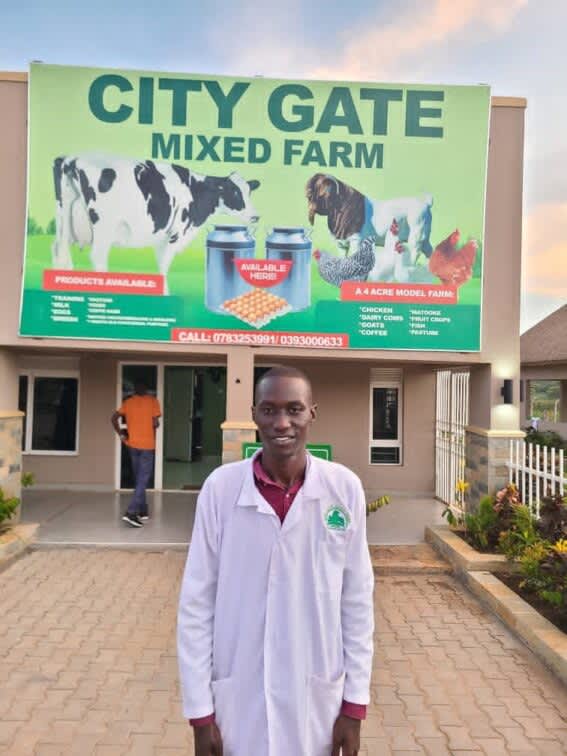
Nek Edwin Ian, City Gate Farm Manager Standing Infront of their office.
Managing the Farm
According to Olam, if one is to manage and yield much from their farm, they must be passionate about what they are venturing into. For him, his happiness is in seeing the livestock that he rears happy which makes him always available at the farm, even though he has some other businesses to run. He also adds that a successful farmer is always patient and never in a rush with his investments.
“It is always a continuous energy that you put on a daily basis until you learn the best. Secondly, the most important thing is, when you’re a farmer and you’re keeping, let’s say you’re keeping the goats, keeping the cows, keeping the chicken, one thing is the chicken or the cows that you’re keeping must be happy. And how do you make them happy? You make them happy by making sure that you put your footprint onto that farm. Now, when I put a footprint on that farm, that means that me myself have to step into that farm almost on a daily or even weekly. I have to be on that farm. So, each time I be on the farm, that means I will see what is wrong and what is not and what is right.”
Additionally, the animal breed selection is very important to have a successful farm. One needs to understand the climate, and geographical location of the farm to understand what breed of animals and crops can survive on such a farm.
Challenges
However, just like there is no success that exists without challenges, the farm experiences challenges like pests and diseases that affect the animals and plants which sometimes if not attended to fast, affects them.
Olam also points out that the climate change also has a great impact on the plants and animals like the goats more especially the exotic breeds that may not be weather resistant.
“Now, let’s talk about the Friesians. Let’s talk about the boar goats that you always import them for South Africa. Sometimes, you know, the weather is always so different. Now, once you bring them here, you might bring them from maybe like from South Africa and find they are in a hot area. Then you reach them here when it’s a rainy season. You find only cough or flu can kill the animals,” he said.
Solutions
Nevertheless, the challenges seem not a big one to the man who is driven by passion to maintain this farm and keep the animals and plants alive and healthy. To solve the hardships, they always choose the right breed of animals and as for the coffee, City Gate farm is investing on Elite Coffee which has more survival rate.
Nek Edwin Ian, the City Gate Farm Manager, also explains that the animals are regularly taken care of properly to avoid them from being attacked by pests and eventually falling sick.
“Then we also do constant spraying of both the goats and the cows. We spray them to prevent ticks from attacking them because the goats mainly are very weak. In case the ticks go and attack them, they are very prone to death, very, very prone to death. But when they get used to the surrounding and the environment, then they can also be groomed like the local goats. You can also leave them to go and eat freely,” Nek explains.
Impact of the Farm
Olam highlights some of the impacts City Gates farm has impacted on him and the people around him saying it has improved his economic status as he gets money from the eggs, chicken, animals, manure and coffee. Beside improving the nutrition of the people at the farm and the people in Lira.
“We always say that agriculture is the backbone of this country. And it is very true. Because you see, now, once you really have something that brings you money on a daily basis, it’s really a good business for me. Now, when you look at chicken and the eggs, because in most cases now, like in Lira, our region here, or our district here, most of the eggs that we get from here always comes from Kampala, from Nakasongola, maybe from Masindi and the rest of other places. Yet all these are things we can do as local people here.”
To add on, the Face of Gulu City 2025/26, Atim Melissa Bridget who is also contestant for Miss Tourism Uganda, Northern Region, also expresses her motivation to start her own farm after a recent visit to City Gate Farm.
“We can be able to eradicate poverty from Northern Uganda and among our people through farming as our back bone in Uganda. You don’t need to start bi, one chicken at home is enough for you start farming and to earn money from it,” Atim commented.
The farm that was started early this year has around 25,000-layer birds, 10,000 broilers for chicken meat production, one bull and ten cows for milk production, with about four calves fed on the pasture that is planted on the same farm. The farm also has another farm in Apac where they are rearing 198 cows on free range system.
The farm makes approximately 10 million shillings everyday from sales made from eggs, milk, manure and others.