


Hi, I am Anguzu, Radio Pacis AI Assistant. How can I help you today? Ask me about Radio Pacis, our programmes, frequencies, news, Arua, or the world around us.
22 March 2026 · Radio Pacis Newsroom
By Anslem Ojaru Arua city We travelled about 20 kilometers to Ayivu West, one of the most malnutrition-affected areas in Arua City, at Uganda’s north-western edge near the DR Congo border. Here, many families struggle to eat even one proper meal a day because
By Anslem Ojaru
Arua city
We travelled about 20 kilometers to Ayivu West, one of the most malnutrition-affected areas in Arua City, at Uganda’s north-western edge near the DR Congo border. Here, many families struggle to eat even one proper meal a day because food production is painfully low.
As you move closer to the border, the air smells of tired, dusty soil. On both sides of the road are gardens—but they are silent. Maize plants are stunted. Cassava leaves are curled and weak. This land has been used again and again, treated with chemicals and forced to produce more. Now, it is failing.
At Odramacaku Market, locally grown food is scarce. Most food here comes from neighboring districts—Maracha, Zombo, Arua—or across the border in the eastern Democratic Republic of Congo.
In Ayivu West—Ayivuni, Adumi, and Pajulu—hunger is quiet. You don’t hear it shout. You see it in empty cooking pots washed early in the day. In school compounds where children sit instead of play. Mothers speak about food carefully, hoping something will change before evening.
Once Arua City’s main market fed thousands. Today, it stands as a reminder of decline. Excessive agrochemical use and nutrient-hungry crops have eaten away soil fertility.
On Wednesday morning, we, met Charles Orindu Oria at his home in Kubo Village. He has lived here for 45 years. Though he owns two acres of land, he has abandoned them due to declining productivity.
“The fertilizers we use here are not the locally made manure, they are four types of chemicals we mostly spread like the dudu cosmetic, with rapid grow and easy grow but have marked some chemicals that are dangerous to our soils like weed master and super master they are spread to burn the grass, I have realized that after using it the soil becomes infertile and fails to produce food,” Mr. Orindu narrates.
For years, Oria was advised to use more fertilizers and chemicals. At first, harvests improved. But later, the soil hardened. When it rains, water runs off. When it’s sunny, the ground cracks.
Near his house lies empty fertilizer bags and other agrochemicals from past seasons. He presses his foot into the soil. Dust rises. The earth is dry and lifeless.
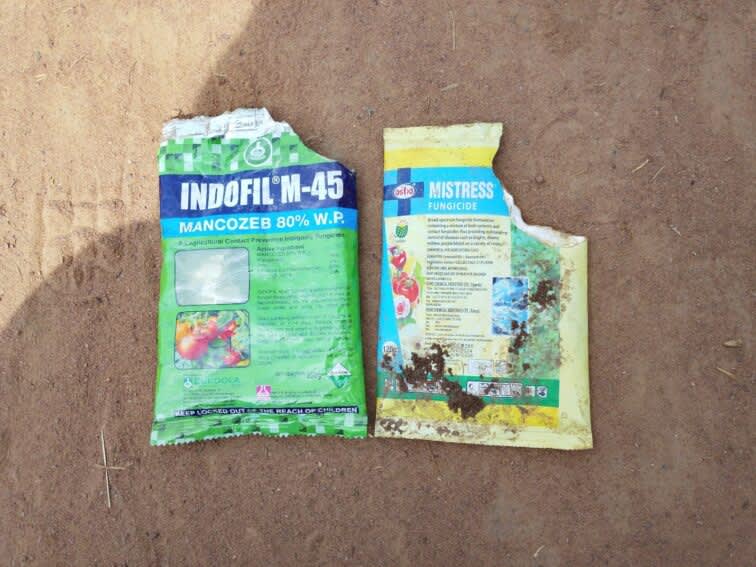
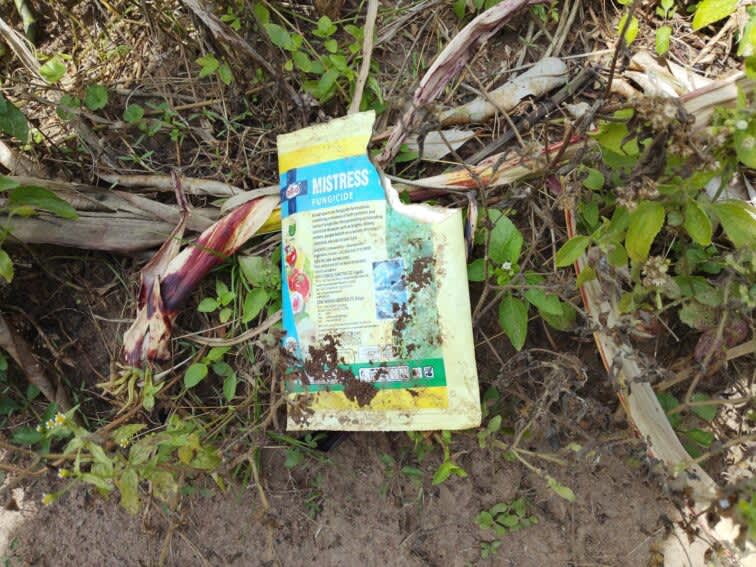
Some of the commonly used chemicals by the farmers in the area.
Oria believes chemicals like weed killers used to clear land before planting have damaged soil fertility.
Mr. Orindu notes that, “When tomatoes are planted they get spoilt and all the efforts and money gets wasted, you end up using 300,000 shilling planting and catering for the tomatoes and you end up getting 200,000shillings , that is a total loss.”
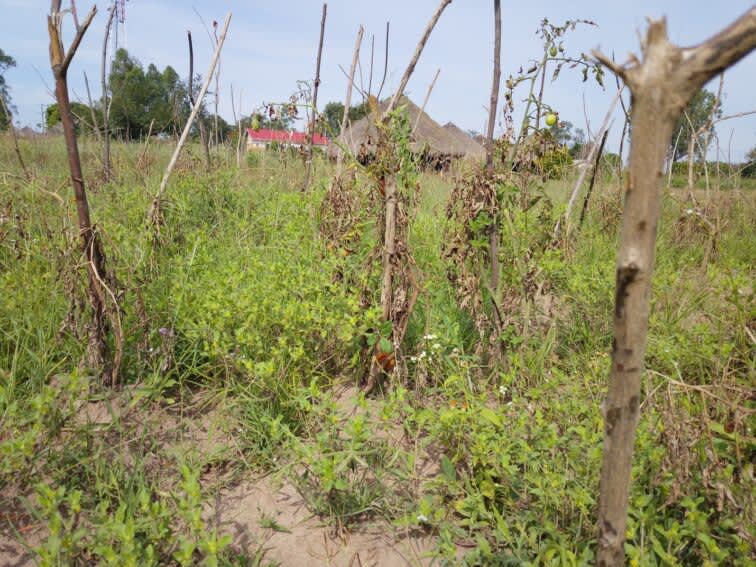
These are some of the tomatoes planted by Orindu
Before, families survived through cross-border trade. Food moved freely from DR Congo to Arua. Today, food prices are high, trade is low, and gardens on both sides of the border are failing.
Among the hardest hit is 23-year-old Jennifer Eyotaru, a breastfeeding mother with a three-month-old baby.
Eyotaru once supported her family through small cross-border trade. But when she gave birth, she spent all her business capital on medical care. Nothing remains to restart.
“There is nothing that can yield even cassava cannot yield from the garden, we are just struggling, if children are malnourished it’s because there is nothing coming from the garden, we depend on bought food from the market because whatever you plant does not yield then there is no use of tilling the land,” she says.
Her husband has no job. The family survives on whatever little she can find, “whatever small we get, that’s what we share with the children and sometimes it’s not enough, am a breastfeeding mother I need enough food but if it’s not there then we stay, because even getting that daily money to feed the family because you have to look for some 10,000shs to trade some vegetables then use the profit for feeding, if there was enough money then we would hire a garden to farm but there is no money for that we have to depend on the little we can afford.”
She looks down at her baby as she feeds him—while she herself has barely eaten. Her story mirrors that of many young mothers here.
According to the Arua City Nutrition Dashboard for FY 2024/2025, 2,212 cases of severe acute malnutrition and Mild Acute Malnutrition were recorded across 35 health facilities. Ayivuni Health Centre III registered the highest number.
Mukail Adam, Arua City biostatistician, says the figures reflect worsening feeding habits in communities.
“According to Ayivuni data they have 39 % of SAM rate and the target is supposed to be less than 10% so this shows that there is food insecurity that side of Ayivuni.”
The situation in West Nile mirrors other parts of Uganda where farmers heavily depend on agrochemicals.
In Kisoga Village, Mukono District, Irene Nakijoba, a smallholder farmer, recalls how their banana plantation was destroyed after chemicals were sprayed to kill banana weevils.
“My father was a public servant under NAADS he used to supply chemicals to the farmers, he used to bring chemicals to us like herbicides, pesticides, fertilizers, conventional we didn’t know that it is affecting our soils our livelihoods and we used to spread and we reached a time even harvesting a small potato was hard also we were going hungry and my father spread banana with Dudu bitooke and all the banana died.”
Earlier, Orindu told us that agrochemicals are sold cheaply in Odramacaku Market, measured in cups, packets, or kilograms depending on a farmer’s budget.
We, took a ride of 12 minutes journey of 6.5Km from the nearest Ayivuni Health Centre III to Odramacaku Market. It’s a beehive of activities in this border market, it’s a hive of activity. One booming business here is agrochemical sales. In every part of this market, there’re shops established basically dealing in these chemicals.
We, met Stella Ayakaka, an agro-input dealer. She has no formal training in agriculture or chemical handling. A Primary Seven dropout, her role is simply to sell. Sharing her experience, Ayakaka said she has not known of any harmful impact of these agrochemicals she is selling to the farmers.
“After selling the chemicals some of them complained I don’t know whether the soils are failing the chemicals have been sold to them but soils have become resistant however I have not had any complain about its harmful impact on the soils.”
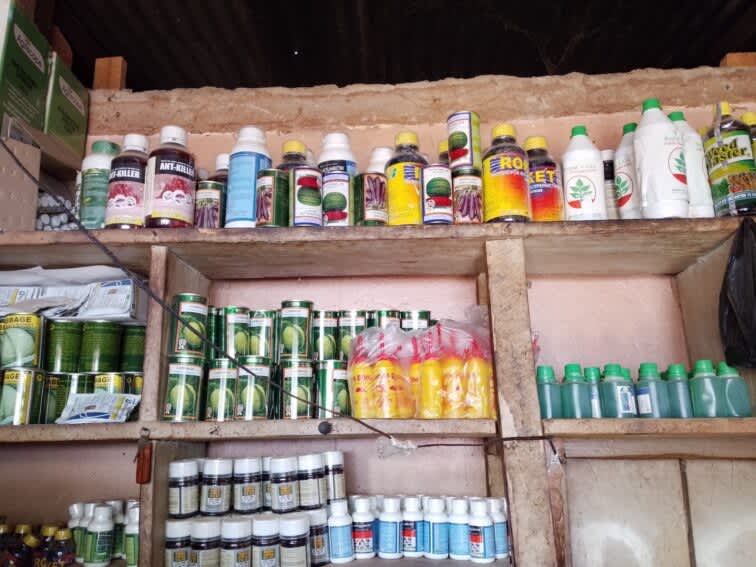
One of the agro chemical outlet where farmers purchase the farm products
Ministry of Agriculture Animal Industry and Fisheries (MAAIF) pesticide database captured at least 548 brand names that were nationally registered as pesticides including 219 insecticides, 115 fungicides and 211 herbicides with at least 41% officially registered different active ingredients were identified as Highly Hazardous Pesticides and are not approved in the European Union.
Whereas The European Commission Regulation No 1107/2009, revealed that 59% of the 41 Highly Hazardous Pesticides (HHPs) identified under current official registration for use in Uganda are currently not approved for use across the European Union.
Nelson Adile, Senior District Agricultural Officer in Arua, says counterfeit chemicals often lack safety instructions.
“Much of the problem that we realized comes from the chain of movement of theses agro chemicals some of these are produced from in other foreign country and imported in the country and there are those chemical distributors who then sell to input dealers and from the input dealers the farmers access them but we do advises and the chain connector the input dealer you should be aware of the classification of the agro chemical you should also know the impact of these chemicals unto the people you are selling.”
The Uganda Registration Services Bureau estimates that 54% of products on the market are counterfeit. The Anti-Counterfeit Goods and Services Bill 2024 still awaits presidential assent.
Other laws like the National pesticide registration and control policy framework, the Agricultural Chemicals (Control) Act 2024 as Amended and The National Organic Food Policy among others that provide for the registration and proper application, transportation, storage, advertisement and disposal of pesticides including the government’s obligation to monitor the efficacy, toxicity and environmental effects of all pesticides have not had any impact on the illicit trade in these chemicals due to weak enforcement, corruption and political interference.
Rose Obiga, Woman MP for Terego District, is pushing for approval of the National Agroecology Strategy a holistic policy framework to transform food systems by integrating environmental, social, and economic goals, addressing climate change, biodiversity loss, food insecurity, and farmer livelihoods while overcoming the harmful impacts of conventional agriculture.
She noted that the value chain for productive agriculture has being disorganized by compromise on law enforcement and farmer illiteracy, “As a parliament yes we have laws but of course there implementation, when we get back to parliament in February, I want to take this as one of my niche.”
Asiimwe Joseph Magabo, Director of Farm Solutions Africa Limited, calls for strict enforcement and adoption of agro ecological practices.
“Make sure the farmers are trained on how to safely use these chemicals, make sure that the chemical they are using are the ones recommended for use, you cannot simply tell farmers go and kill the pests and also control the diseases or even apply the fertilizers we need to teach the farmers a how effectively they can apply us the fertilizers, how they can conserve their soil and water we need to teach the farmers when it is right to spread.”
The continued use of hazardous agrochemicals in Uganda that have been banned world over contradicts the UN Sustainable Development Goals and threatens food security.
Dr Emmanuel Odama, soil fertility scientist at National Agricultural Research Organization NARO, says soils are suffering from nutrient mining.
“Make sure you reserve the crop residuals instead of harvesting everything, why don’t you harvest what you need to eat and leave the rest as co residual because thats the only way the organic material will convert to organic matter and it will improve a lot of things on the soils, the fertility of the soil.”
According to MAAIF, Agriculture employs over 70% of Uganda’s workforce, yet the country loses about 200 million dollars annually in exports to markets in the European Union (EU) and the United Kingdom due to among others banned chemical use.
Uganda is now recognized as a hotspot for fake agrochemicals. This crisis goes beyond MAAIF. It requires action—from farmers, leaders, regulators, and consumers—to protect people, soils, and future food systems.