


Hi, I am Anguzu, Radio Pacis AI Assistant. How can I help you today? Ask me about Radio Pacis, our programmes, frequencies, news, Arua, or the world around us.
24 March 2026 · Radio Pacis Newsroom
Newly elected Acholi MPs and LC5s pose with the OWC team at Gulu Logistics Hub. By Proscovia Achomo Gulu City Leaders from the Acholi sub-region have sounded the alarm over the region’s unclear land ownership, saying it is a major barrier to investment and eco
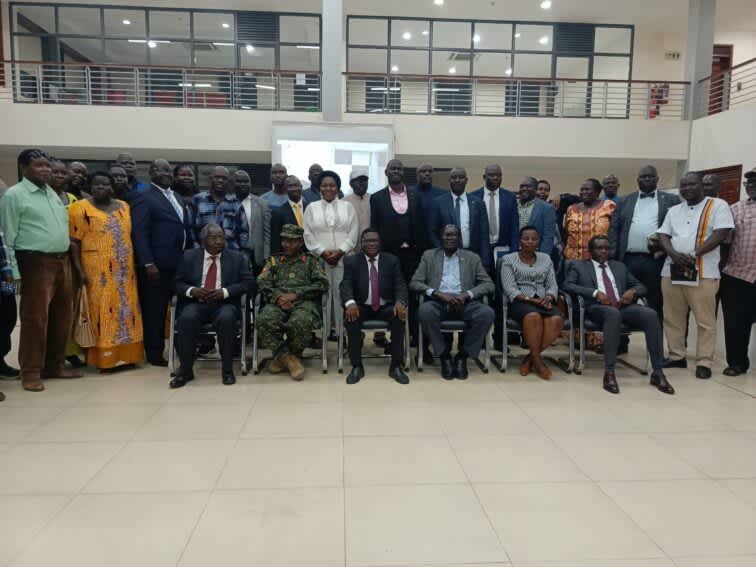
Newly elected Acholi MPs and LC5s pose with the OWC team at Gulu Logistics Hub.
By Proscovia Achomo
Gulu City
Leaders from the Acholi sub-region have sounded the alarm over the region’s unclear land ownership, saying it is a major barrier to investment and economic growth. Legislators are worried that if the issue is left unaddressed, large portions of Acholi’s customary land could be lost under unclear circumstances, undermining opportunities in agriculture, real estate, and other commercial sectors.
Bardege-Layibi Division legislator Martin Ojara Mapenduzi said investors repeatedly expressed concerns over the risks of acquiring land under the customary system, where ownership is communal and often undocumented.
“Many of the investors have talked about land. They say our land ownership question is a little tricky and risky for them,” Mapenduzi said. “Some investors need large tracts of land, especially in agriculture. But financiers are not comfortable because you may have thousands of acres that you want to partner on, yet you don’t have a document since it is customarily owned and not owned by just one household.”
Kilak North Member of Parliament Anthony Akol called for the creation of a dedicated registry for customary land, arguing that formal documentation would allow landowners to access loans and give investors’ confidence to commit resources to the region. “There must be a registry for customary land ownership so that we have the same level as other land tenure systems such as leasehold, freehold or mailo,” Akol said.
Meanwhile, the Woman Member of Parliament for Agago District, Beatrice Akello Akori, who is also State Minister for Economic Monitoring in the Office of the President, warned that continued silence on land issues is creating a time bomb.
“This customary land, like in my district Agago, by the time we wake up we may not find it. When a child is sick someone sells five acres, someone wants to marry and sells ten acres. By the time we wake up to think about productive ways of using this land, it will all be gone,” Akori said.
The Minister for Northern Uganda, Kenneth Omona, added that the value of land is often underestimated, and warned that failing to appreciate it at leadership level puts the entire region at risk.
“It seems people don’t understand the value of land. The biggest wars fought in the world are about land or space. If leaders don’t appreciate the value of what they have, then what about the locals?” Omona said. He urged that Acholi develop its own laws or regulations on land to protect communities and guide investment. “We need to improve the laws that govern how we handle land so that customary ownership is secure and the region can plan for development,” he added.
According to official figures, the Acholi sub-region covers 2.8 million hectares of land. By June 2025, 610,000 hectares had been surveyed and titled, while approximately 54,940 hectares are yet to be titled. The region has 46,869 households and hosts 2,841 foreign investors, highlighting its significant investment potential once land ownership challenges are resolved.
Speaking during the proliferation of the Acholi Investment Profile at the Gulu Logistics Hub, the Minister for Disaster Preparedness, Hillary Onek said the absence of clear land titles remains a major bottleneck to development, contrasting Acholi with regions like Buganda where investors can legally negotiate land deals.
“You go to Buganda; the entire land has ownership with titles. Whether it is mailo land or otherwise, there are titles. If an investor comes, they bargain with the landowner for value. That value helps the owner to develop,” he said.
He added that he proposed systematic land titling in Acholi as early as 2006 during his tenure as agriculture minister, including issuing titles for communal land held in trust by clans or traditional leaders, but the proposal was never implemented.
Meanwhile, The Minister for Justice and Constitutional Affairs, Norbert Mao, also challenged leaders and residents to take pride in the region and actively promote it, noting that the Acholi Investment Profile aims to position the region for economic growth after decades of disruption caused by the insurgency of the Lord’s Resistance Army.
“We need to market our home and be the first people to love it before expecting others to love it,” Mao said. “How can we expect tourists from Germany to visit places like Aruu Falls if some of us who live here have never visited them?”
He also noted that many leaders are unfamiliar with some key tourism attractions in the region, including Guru Guru Hill and the Paimol Martyrs’ Shrine associated with Janani Luwum.
During the meeting organized by Operation Wealth Creation, Kenneth Oketa, Team Leader at the Information Management Centre, highlighted several investment opportunities in the region stating that Acholi offers strong investment opportunities in commercial agriculture, agro-processing, livestock farming, oilseed processing, forestry, tourism, and infrastructure development. The region’s fertile land and growing government-backed economic programs position it as a promising destination for both local and international investors.
Oketa noted that the Acholi sub-region has vast land suitable for investment, particularly in commercial agriculture. However, he said many potential investors and even local leaders lack adequate information on how such opportunities can be accessed.
“We want the new leadership for the 2026–2031 term to be oriented toward wealth creation so that they understand the investment environment of the sub-region,” Oketa said. “Through data, pictures, and a proper investment profile, we can show that the land and resources here can be put to productive use and attract investors.”