


Hi, I am Anguzu, Radio Pacis AI Assistant. How can I help you today? Ask me about Radio Pacis, our programmes, frequencies, news, Arua, or the world around us.
10 March 2026 · Radio Pacis Newsroom
Street Vendors along Market lane in front of Arua Main Market. All photos by Federick Dramadri. By Dramadri Federick Arua city Vendors operating in Arua Main Market have protested the delayed implementation of the Arua City Trade Order, an initiative intended
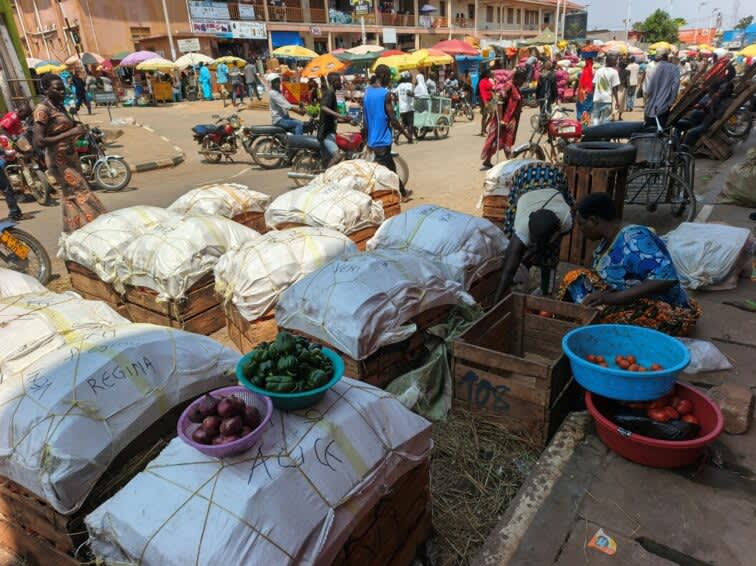
Street Vendors along Market lane in front of Arua Main Market. All photos by Federick Dramadri.
By Dramadri Federick
Arua city
Vendors operating in Arua Main Market have protested the delayed implementation of the Arua City Trade Order, an initiative intended to eliminate street vending and promote fair trade among vendors operating within gazetted markets.
The vendors accuse Arua City Council of allegedly legalizing street vending, a move they say undermines efforts to enforce the programme aimed at clearing city streets that have been flooded by vendors.
Beatrice Eyotaru, the Secretary General of the Arua Main Market Vendors Association, revealed that the city council continues to collect revenue from street vendors—an action she says is encouraging disorder in the city.
“The city council continues collecting money and issuing receipts to street vendors every day, yet we—the vendors inside the market—pay more than double in taxes plus rent fees. Some of these vendors even have stalls inside the main market. Why can’t they be pushed back into the market?” Eyotaru questioned.
Faidah Gloria, the vendors’ representative to the Arua City Development Forum, also questioned why the city council continues to tolerate street vending while several business spaces inside the market remain vacant.
“There are over 2,000 vacant stalls, including lockups, inside the market. Most vendors have moved out. We are disappointed because the few of us who remain inside the market are no longer making sales, and we do not understand the council’s decision,” Gloria explained.
Currently, more than 2,000 stalls remain unoccupied in the UGX 34.9 billion Arua Main Market, which was constructed with funding from the African Development Bank through the Markets and Agricultural Trade Improvement Programme.
Herbert Odama, the Chairperson of the Vendors Association at Arua Main Market, says the city council is unfairly treating legitimate vendors who operate within the market. He added that authorities should reconsider their actions, warning that vendors may be forced to close the market if the situation is not addressed.
“You announce something to the public but fail to implement it. I don’t see how serious the government is. Otherwise, these are some of the things that can take us backwards,” Odama said.
Arua Main Market was constructed to accommodate at least 5,000 vendors, but currently about 755 stalls and more than 300 lockups remain unoccupied, according to records at the office of the Vendors Association chairperson.

Arua City Town Clerk responding to the vendors concerns in his Office.
Meanwhile, David Kyasanku, the Arua City Town Clerk, said enforcement will be carried out once the city council is fully prepared, though he did not provide detailed reasons for the delay.
“We need to be properly ready. Being ready means having the necessary logistics. We also want to ensure people understand that we are not chasing them like animals. We will invite stakeholders for final consultations, after which a date for enforcement will be announced,” Kyasanku said.
Throughout February 2026, Arua City Council spent taxpayers’ money on radio announcements warning street vendors to vacate the streets. The announcements indicated that enforcement would begin on Monday, 23 February 2026, but the directive has not yet been implemented.
The Trade (Licensing) Act of 1969 mandates local governments to ensure that vendors operate legally from gazetted or authorized spaces, such as government-run or private markets, rather than on road reserves, pedestrian walkways, or traffic islands. Offenders, once convicted, may face fines ranging from UGX 200,000 to UGX 600,000, or imprisonment for two to six months.