
Hi, I am Anguzu, Radio Pacis AI Assistant. How can I help you today? Ask me about Radio Pacis, our programmes, frequencies, news, Arua, or the world around us.
19 March 2026 · Radio Pacis Newsroom
Muni University Officials and Partners during a press briefing a head of the official launch of MUILG. By Dramadri Federick Arua City Muni University is set to officially launch the Muni University Institute of Leadership and Governance (MUILG) the first of it
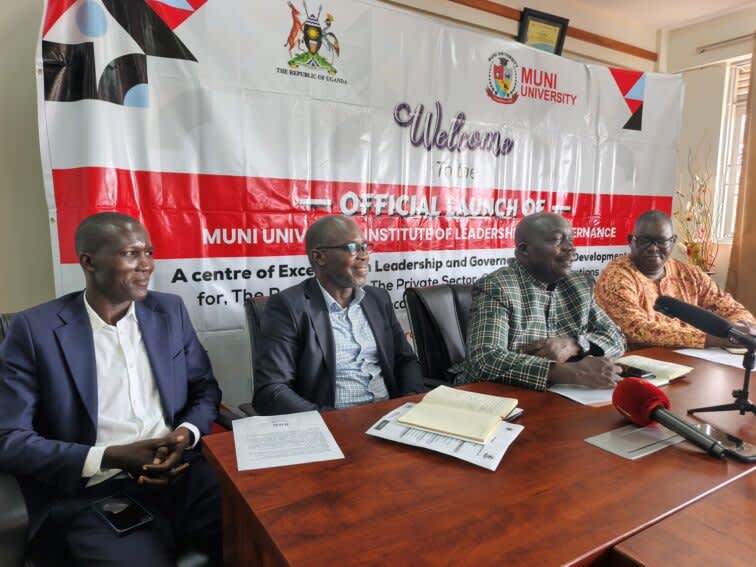
Muni University Officials and Partners during a press briefing a head of the official launch of MUILG.
By Dramadri Federick
Arua City
Muni University is set to officially launch the Muni University Institute of Leadership and Governance (MUILG) the first of its kind in Uganda on Monday, March 23, 2026, in a landmark step toward strengthening leadership systems in the country.
The institute, a non-academic capacity-building Centre, has been established in partnership with West Nile Development Association (WENDA) and VNG International. It aims to enhance leadership and governance across public, private, and civil society sectors, with a strong focus on ethical leadership, regional transformation, and strategic alignment for sustainable socio-economic development.
According to Simon Anguma Katrini, the Vice Chancellor of Muni University, the institute comes at a critical time when local governments in the West Nile sub-region continue to struggle with weak leadership capacity, resulting in poor service delivery.
“Through the establishment of this institute, we want to see a society in the West Nile Region that is better led, better governed, and better served,” he emphasized.
The establishment of MUILG also responds to mounting socio-economic pressures in the region. Eight out of the 15 local governments in West Nile currently host over 1.2 million registered refugees at peak levels, placing significant strain on already limited resources. These include infrastructure, water, education, and healthcare services often without corresponding increases in local government funding.
The situation is further complicated by the growing number of self-settled refugees in urban centres, coupled with policy gaps regarding their recognition and management. This has left local governments struggling to equitably serve both refugee and host communities with constrained support from the central government.
The institute will be officially launched by Raphael Magyezi, Uganda’s Minister of Local Government, at the university campus.
Meanwhile, Moses Akuma Odims, Executive Director of WENDA, highlighted the region’s leadership instability, noting a high turnover among political leaders. “Out of the 15 local governments in the region, only six leaders have been retained across election cycles. The majority are new and lack experience in local governance and leadership,” he said, stressing the need for continuous induction and capacity-building programmes.
The West Nile region remains one of Uganda’s most vulnerable sub-regions, with poverty levels significantly higher than the national average. It is often ranked alongside Karamoja and Acholi as a poverty hotspot. Current data indicates high food insecurity levels ranging between 67.8% and 72.3%, widespread child poverty, and youth unemployment, with nearly 60% of young people not engaged in education, employment, or training.
Twaib Feni, Chief Executive Officer of the West Nile Civil Society Network, has called on the institute to address governance-related conflicts within local governments. “We need to resolve governance challenges, particularly those arising from power struggles, resource allocation, and authority. These issues affect not only the region but the country as a whole,” he noted.
Muni University has already begun rolling out targeted capacity development programmes for local government leaders in districts such as Yumbe, Terego, and Koboko Municipality. The institute is expected to deliver practical, evidence-based training informed by research and community engagement, ensuring solutions are tailored to local needs.
Additionally, MUILG will play a key role in aligning district development plans in West Nile with national and global frameworks, including Uganda Vision 2040, African Union Agenda 2063, and the United Nations Sustainable Development Goals, ensuring the region remains on track in the broader development agenda.