

Hi, I am Anguzu, Radio Pacis AI Assistant. How can I help you today? Ask me about Radio Pacis, our programmes, frequencies, news, Arua, or the world around us.
1 July 2026 · Radio Pacis Newsroom
Engineer Joel Aita the Chairman University Council during the presentation of the planed teaching hospital and research facility outlook. By Dramadri Federick Arua City Muni University has unveiled plans for a Shs160 billion state of the art teaching hospital
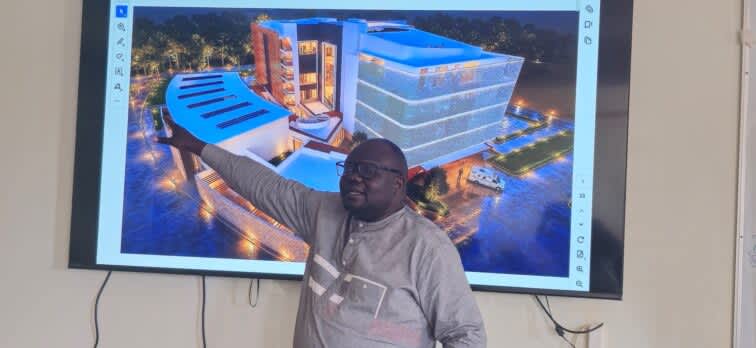
Engineer Joel Aita the Chairman University Council during the presentation of the planed teaching hospital and research facility outlook.
By Dramadri Federick
Arua City
Muni University has unveiled plans for a Shs160 billion state of the art teaching hospital project aimed at expanding medical training, strengthening health research, improving access to specialized healthcare services, and increasing the institution’s capacity to generate revenue.
The proposed teaching hospital, which will be constructed in phases, is expected to position the university as a major centre for medical education and specialized healthcare delivery in the West Nile Sub-region and beyond.
According to the university management, the government has already provided Shs30 billion as start-up funding for the first phase of the project, with additional funding expected through annual budget allocations until the entire project cost is achieved.
The facility, expected to be completed within two and a half years after commencement of works, will include a medical wing, biomedical block, and administration building.
Speaking during a media briefing at the project unveiling, Muni University Vice Chancellor Associate Professor Simon Katrini Anguma said the institution received an executive directive from the President authorizing the award of the construction contract to Roko Construction Limited.
He said all preparations are complete for the groundbreaking ceremony scheduled for 10th August 2026.
“Government has already approved and released 30 billion shillings as start-up funds for the construction of the university teaching hospital. This project will run for two and a half years, meaning each financial year appropriations will be made, and when added together, the total investment will amount to 160 billion shillings,” Anguma explained.
The architectural design of the teaching hospital includes several specialized facilities expected to improve healthcare services and provide practical training opportunities for medical students.
Among the planned facilities are a mortuary with a cold room capable of preserving up to 100 bodies, a pathology and investigations laboratory, an eight-bed dialysis unit for kidney patients, organ transplant theatres, an Intensive Care Unit (ICU), a fertility centre, and a sperm bank.
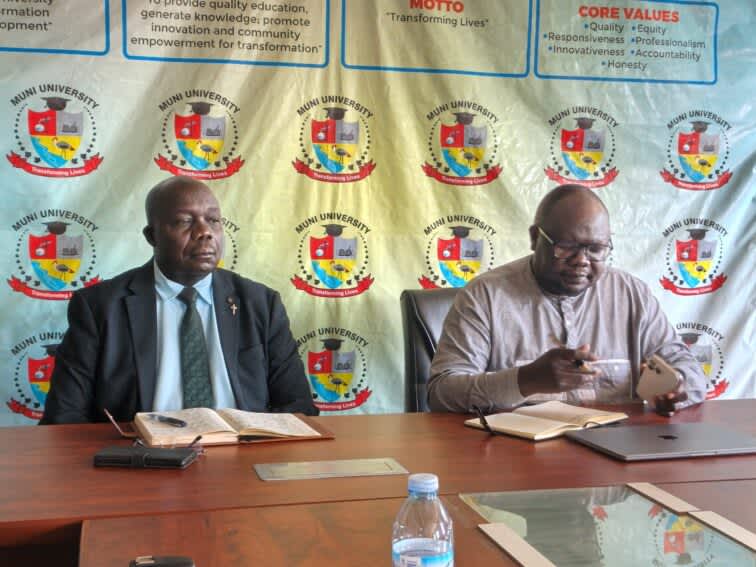
Associate Professor Simon Katrini Anguma the Vice Chancellor and Eng Joel Aita during the media Briefing at the University boardroom.
Professor Anguma said the hospital will not only serve as a training centre for students but also provide specialized medical services that are currently unavailable in many parts of the country.
He explained that the university plans to recruit highly qualified specialists locally and internationally to teach, mentor students, and deliver advanced healthcare services.
“We do not want to disrupt the nearby health facilities because they may not be ready to surrender their staff to work with us. Therefore, we shall ensure that the best specialists are vetted and recruited to teach and provide specialized medical care services,” Anguma said.
The Chairperson of the University Council, Engineer Joel Aita, described the project as a timely government investment that will support the expansion of academic programmes and improve access to quality healthcare.
Aita said the teaching hospital is expected to contribute towards reducing the need for Ugandans to travel abroad in search of specialized medical treatment.
“We are looking at a high-end hospital that will ensure there is no more medical tourism where members of the public go outside Uganda to seek services from specialized doctors,” Aita said.
The hospital is also expected to strengthen research and innovation, create employment opportunities, and support the growth of medical-related programmes at Muni University.
Established in 2014, Muni University has expanded significantly, growing from an initial 87 students enrolled in two academic programmes to 3,843 students pursuing 32 programmes.
University officials say the teaching hospital represents a major milestone in the institution’s journey to become a leading centre for health sciences training, research, and specialized healthcare delivery in Uganda.