


Hi, I am Anguzu, Radio Pacis AI Assistant. How can I help you today? Ask me about Radio Pacis, our programmes, frequencies, news, Arua, or the world around us.
29 July 2025 · Radio Pacis Newsroom
The NWSC Engineer demonstrating how the hub operates. By Proscovia AchomoGulu City In a significant move aimed at improving access to clean and affordable water, National Water and Sewerage Corporation (NWSC) Gulu Area has launched a prepaid water meter system
The NWSC Engineer demonstrating how the hub operates.
By Proscovia Achomo
Gulu City
In a significant move aimed at improving access to clean and affordable water, National Water and Sewerage Corporation (NWSC) Gulu Area has launched a prepaid water meter system targeting underserved and vulnerable communities.
The innovative system allows customers to pay in advance for water using tokens, giving them control over their consumption while avoiding the stress of monthly bills. Water will cost only 25shillings per unit for 20 litters under the new system.
According to commercial officer NWSC Gulu, Proscovia Nyamungu, the project aims to serve 7,389 customers across Gulu. So far 140 prepaid meters (PPMs) have been installed in areas such as Lacor, Unyama and Koro Abili.
However, only 170 people have registered to access the service, Negri Cell, Goans Quarter, Bus Park A & B, Keyi A & B, among others -a gap NWSC attributes to limited community awareness. “We believe this system will go a long way in supporting low-income households. It ensures that people pay for only what they use and helps eliminate illegal connections,” Proscovia said.
She added, “we have been having the program of water kiosks in the community but we realized that it was not being effective, so we decided to come up with the PPM and the PPM is bought using mobile money and you pay only 25shs for a 20 litters jerrycan and with this you go with your token, fix it and fetch the water without anyone asking you for money, so it is very affordable to the pro poor.”
To register for the service, residents are required to submit a passport -size photo, a letter from their LC1 chairperson, and a valid form of identification-either a National ID, refugee ID, or passport.
Local leaders have welcomed the initiative with optimism. The LC1 chairperson of one of the beneficiary communities, Holy Rosary, Joyce Oryem commended NWSC for the intervention but urged for more support in sensitizing users.
“My hope is that whenever people come to fetch water, there will be someone stationed at the hub to guide them, as there is still gap in understanding the new system, “the chairperson appealed.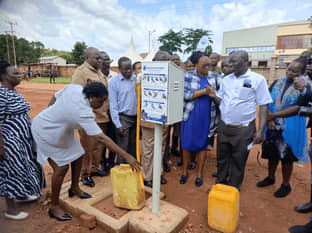
Residents being shown how to access clean
water through the prepaid meter system
during a practical demonstration by NWSC staff.
Christine Olok, the deputy mayor, Gulu City welcomed the initiative and appreciated NWSC for selecting Gulu City as the second city in Uganda to have the PPMs after Kampala.
“We all believe in the saying that water is life and as leaders of Gulu city, we feel blessed for having been accorded the first pilot city for this initiative because we are second to Kampala. And with this venture, matters of water problem shall be improved in Gulu City, as it will be affordable and accessible to especially the underserved community because not everyone in Gulu city has access to National Water,” Olok stated.
Speaking after the official launch, Edward Wesonga Rodney PPM consultant, Ficher Water and Transportation praised NWSC for prioritizing a customer-centered approach, noting that the prepaid system empowers households to manage their water usage more efficiently while reducing the burden of unpredictable monthly bills.
He continued that the system uses smart technology that allows customers to load credit onto a token. Once the prepaid credit is used up, the system automatically stops the water flow, promoting conservation and preventing wastage.
Addressing the matter of inclusivity, Caroline Rose Adong, councilor representing persons with disability for Gulu City council called for specific support to enable visually impaired individuals to access the prepaid water system with dignity and ease.
“Inclusivity must be at the heart of service delivery. People who ae blind or visually impaired should not be left behind simply because the system is digital. We are requesting NWSC to consider user-friendly adaptations-like tactile buttons or support staff-to ensure everyone benefit,” Adong urged.
NWSC has pledged to increase sensitization and is considering deploying staff to water points to support and guide users, especially in high-demand areas.
The system is also expected to reduce illegal connections, and ensure fairness in water distribution, especially in peri-urban areas where access has historically been a challenge.
NWSC currently supplies clean water to over 341,000 people in Gulu City and surrounding areas, with plans to expand coverage to approximately 484,000 residents through ongoing infrastructure upgrades.