
Hi, I am Anguzu, Radio Pacis AI Assistant. How can I help you today? Ask me about Radio Pacis, our programmes, frequencies, news, Arua, or the world around us.
22 March 2026 · Radio Pacis Newsroom
Refugees in tank 11 struggling to fetch water (Photo by Samson Ganiko) By Ganiko Samson Bullen Moyo Refugees in Tank 11, Zone Two of Palorinya Refugee Settlement in Obongi District are calling on implementing partners to urgently intervene, citing severe chall
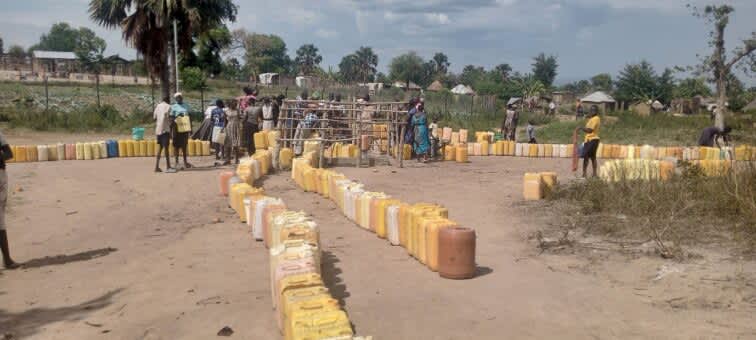
Refugees in tank 11 struggling to fetch water (Photo by Samson Ganiko)
By Ganiko Samson Bullen
Moyo
Refugees in Tank 11, Zone Two of Palorinya Refugee Settlement in Obongi District are calling on implementing partners to urgently intervene, citing severe challenges in accessing clean water.
According to the residents, the increasing number of new arrivals has led to congestion at the only available water source.
Palorinya Refugee Settlement is currently hosting over 142,905 refugees.
By press time, Poni Harriet, a resident of Tank 11, told Radio Pacis at around 3:00pm that she had been waiting since morning, but had not yet managed to fetch water.
“We are suffering so much here in Tank 11 trying to fetch water. I came at around 10:00am, and up to now I have not fetched any water. Partners, please come and help us,” Poni appealed.
Modong Jean said the struggle for water has sparked conflicts, especially with new arrivals, as they all depend on the same limited resource, which is also shared with nearby schools.
“We are suffering due to lack of water. There is always no water, and we are even fighting with new arrivals over it,” she revealed.
Meanwhile, Meling Margret Duku, the lead caregiver at Sacred Heart ECD Centre, said the school community is equally affected since they depend on the same water source.
“Both the community and the school depend on this one water source. Sometimes we go to school without water, which affects learning. Children cannot stay without water, and at times we are forced to send learners back home,” Meling explained.
In response, Kenyi Emmanuel Moga, the RWC II Chairperson for Zone Two, said the Water, Sanitation And Hygiene (WASH) project is being implemented by the Lutheran World Federation (LWF), explaining that water is pumped using solar-powered systems from underground to areas where boreholes cannot be established.
“The challenge now is the operation of the system. There is lack of fuel at the pump stations, and the water levels are also low. This has greatly contributed to the shortage of water, and Zone Two is badly affected,” he noted.