

Hi, I am Anguzu, Radio Pacis AI Assistant. How can I help you today? Ask me about Radio Pacis, our programmes, frequencies, news, Arua, or the world around us.
3 June 2026 · Radio Pacis Newsroom
His Grace Raphael P’Mony Wokorach while delivering his homily at St. Josephs’ cathedral Gulu. By Biko Rombe Gulu City As Christians across Uganda commemorate Uganda Martyrs’ Day, the Archbishop of Gulu, His Grace Raphael P’Mony Wokorach, delivered a powerful m
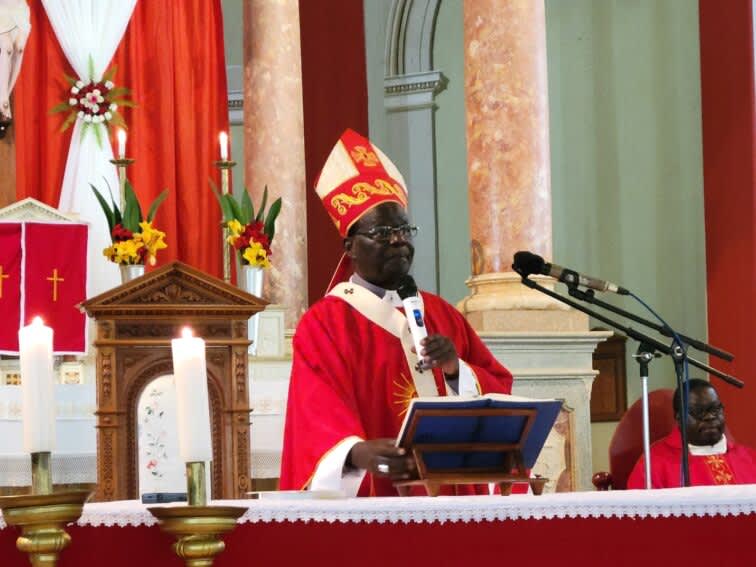
His Grace Raphael P’Mony Wokorach while delivering his homily at St. Josephs’ cathedral Gulu.
By Biko Rombe
Gulu City
As Christians across Uganda commemorate Uganda Martyrs’ Day, the Archbishop of Gulu, His Grace Raphael P’Mony Wokorach, delivered a powerful message urging young people to emulate the courage, conviction, and faith of the Uganda Martyrs by standing firm against evil and remaining faithful to their beliefs despite modern-day challenges.
Speaking during the Martyrs’ Day celebrations at Gulu Cathedral, Archbishop Wokorach reflected on the history of the Uganda Martyrs, emphasizing that most of the martyrs were young men whose faith transformed them into courageous witnesses willing to sacrifice their lives rather than abandon Christian values.
The archbishop traced the origins of Christianity in Uganda, explaining that Muslim traders had arrived in Buganda kingdom long before Christian missionaries. The first Protestant missionaries reached Buganda in 1877, followed by the Catholic White Fathers in 1879 during the reign of Kabaka Muteesa I, who welcomed them and allowed them to spread the Gospel.
However, the situation changed dramatically when Kabaka Mwanga II ascended to the throne after his father’s death. According to Archbishop Wokorach, Mwanga became increasingly suspicious of the growing Christian movement within his palace. Many of the young pages serving in the royal court had embraced Christianity and began living according to its teachings.
“These were young people chosen from different clans to serve the king,” Archbishop Wokorach explained. “But when they encountered the Gospel, their attitudes changed. They learned to obey God’s law, to pray, to worship, and to place their faith above everything else.”
The archbishop said the young converts began refusing practices that contradicted their new faith. They observed Sundays as days of worship, abandoned traditional practices they considered incompatible with Christianity, and openly professed their loyalty to God. Such actions, he said, alarmed the king and those around him.
Mwanga’s fears were further fueled by advisers, traditional spiritual leaders, and other groups who viewed Christianity as a threat to their influence. The archbishop noted that some traditional practitioners lost followers as more people converted to Christianity, while others worried that the new religion was undermining long-established systems within the kingdom.
Tensions continued to rise between 1877 and 1885, culminating in the execution of some of the earliest Christian converts. Archbishop Wokorach highlighted the story of St. Joseph Mukasa Balikuddembe, the first of the Uganda Martyrs, who was killed in November 1885 after courageously confronting Kabaka Mwanga over the killing of Anglican Bishop James Hannington.
“Joseph Mukasa stood before the king and told him that killing was wrong,” the archbishop said. “He knew the commandment of God. He understood that no one has the right to take another person’s life. For speaking the truth, he was killed.”
The archbishop described this act as one of the greatest examples of faith-driven courage. In a society where absolute obedience to the king was expected, Mukasa chose obedience to God over obedience to earthly authority.
“Faith changed the hearts of these young men,” he said. “It gave them the courage to say no to evil, even when saying no meant death.”
Another martyr whose story featured prominently in the archbishop’s homily was St. Denis Ssebuggwawo, a young catechumen who was deeply committed to learning the Christian faith. Despite being favored by the king, Denis remained dedicated to his religious instruction. When questioned about his whereabouts after attending catechism lessons, he openly admitted his commitment to Christianity and was executed.
For Archbishop Wokorach, the story of Denis and the other martyrs remain especially relevant for today’s youth.
“The Uganda Martyrs were young people,” he said. “They faced pressure, temptation, threats, and persecution. Yet they remained faithful. Their witness teaches today’s young generation that faith requires courage.”
Drawing parallels between the challenges faced by the martyrs and those confronting young people today, the archbishop encouraged youth to resist peer pressure, corruption, dishonesty, substance abuse, sexual immorality, and other forms of wrongdoing.
“The lesson of the Uganda Martyrs is simple,” he said. “Learn to say no to evil. Say no to lies, no to jealousy, no to manipulation, no to crime, no to corruption. Faith gives us the strength to make the right choices.”
The archbishop also emphasized that martyrdom is not only about shedding blood. He challenged Christians to become what he called “white martyrs”—people who make daily sacrifices by rejecting sin and living according to God’s commandments.
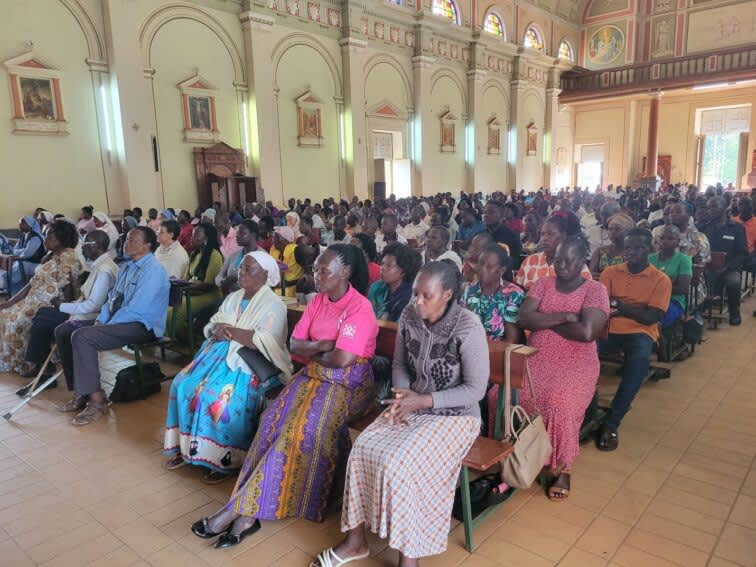
Congregants during the martyr’s days Mass
Following the Mass, young Catholics expressed how the archbishop’s message resonated with them.
Flavia Rebecca Atimango, a member of the choir at Gulu Cathedral, said the celebration reminded her of the importance of remaining faithful despite difficulties.
“The Uganda Martyrs were young people like us,” she said. “Their faith encourages me to stand firm and trust God even when facing challenges and temptations.”
ATimango noted that the courage demonstrated by the martyrs continues to inspire young Christians to remain committed to prayer and Christian values.
Another parishioner, Andrew, described the Martyrs’ Day celebration as a moment of deep reflection for young people. He said the lives of the martyrs prove that age is not a barrier to witnessing Christ.
“Nobody is too young to be a witness of Christ,” he said. “The Uganda Martyrs were youth, and they transformed history through their faith. That challenges us to use our energy and talents to serve God and become role models in our communities.”
Andrew added that the example of the martyrs calls young people to become ambassadors of peace, reconciliation, integrity, and service in society.
The archbishop concluded by reminding Christians that the Church officially recognized the heroism of the Uganda Martyrs through their beatification in 1920 by Pope Benedict XV and their canonization in 1964 by Pope Paul VI.
As Uganda marks another Martyrs’ Day, Archbishop Wokorach’s message remained clear: the courage that transformed a group of young pages in the royal court more than a century ago is still needed today. In an age marked by growing social pressures and moral challenges, the witness of the Uganda Martyrs continues to call young people to stand firm in faith, reject evil, and become courageous disciples in their generation.
The celebration at St. Joseph’s Cathedral attracted more than 100 worshippers, many of them young people who said the witness of the Uganda Martyrs continues to inspire their faith and daily lives.