


Hi, I am Anguzu, Radio Pacis AI Assistant. How can I help you today? Ask me about Radio Pacis, our programmes, frequencies, news, Arua, or the world around us.
13 March 2026 · Radio Pacis Newsroom
By Dramadri Federick Arua The Government of Uganda has initiated plans to amend the Firearms Act of 1970 in a move aimed at tightening gun control, curbing the proliferation of illegal firearms, and strengthening accountability in the use of weapons across the

Stakeholders from National Focal Point on Small Arms and Light Weapons (NFPSALW) to Arua district pause for Photo (Photo by Dramadri Federick)
By Dramadri Federick
Arua
The Government of Uganda has initiated plans to amend the Firearms Act of 1970 in a move aimed at tightening gun control, curbing the proliferation of illegal firearms, and strengthening accountability in the use of weapons across the country.
The proposed amendments, currently under consideration by the Parliamentary Council, introduce tougher penalties for firearm-related offences, higher licensing fees for gun ownership, and stricter requirements for individuals seeking to legally acquire firearms.
Higher Gun License Fees Proposed
One of the most notable changes in the draft legislation is the proposal to increase the cost of acquiring a gun license from UGX 150,000 to UGX 5 million. Authorities say the steep increase is intended to discourage unnecessary civilian gun ownership and promote responsible firearm use.
The bill also proposes eliminating fines for certain firearm-related offences and replacing them with direct custodial sentences ranging from 10 years to life imprisonment, depending on the severity of the crime.
Changes in Authority to Issue Gun Licenses
The proposed amendments also seek to reform the system used to approve firearm ownership.
Under the current law, the Inspector General of Police (IGP) holds the authority to issue firearm licenses.
However, the new draft law recommends transferring this responsibility to the Arms Management and Disarmament Committee, a move officials say will enhance transparency, oversight, and accountability in the licensing process. This process starts from the Village taskforce committee, to Parish, Sub County and the District committee which should comprise of the Religious leader, cultural representative, women and youth besides security personnel representation to sieve the applicants.
It is also mandatory for the spouse to append his or her signature on the application form to confirm consent and clear justification if such an applicant seeking a gun is a married person.
Mandatory Firearm Training for License Applicants
Another key provision in the proposed law is the introduction of mandatory competency certification in firearm handling.
Civilians and personnel from private security organizations intending to acquire firearms will be required to obtain a certificate from a recognized firearm training institution, demonstrating that they have the necessary skills and knowledge to safely handle weapons.
Authorities say this requirement will ensure that only trained and responsible individuals are granted firearm licenses.
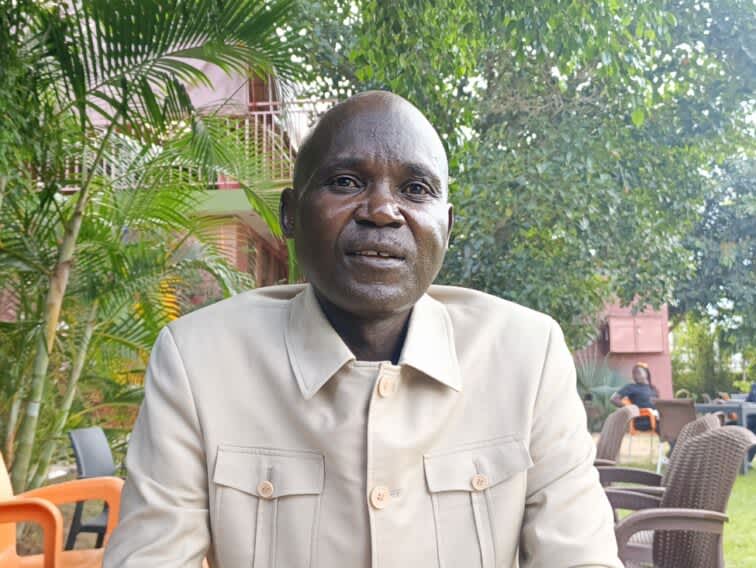
Anthony Nakhaima, the Deputy National Coordinator of the Uganda National Focal Point on Small Arms and Light Weapons (NFPSALW) at the Ministry of Internal Affairs (Photo by Dramadri Federick)
Anthony Nakhaima, the Deputy National Coordinator of the Uganda National Focal Point on Small Arms and Light Weapons (NFP/SALW) at the Ministry of Internal Affairs, said the existing law no longer reflects current security realities.
According to him, the regulatory framework governing firearms has failed to keep pace with evolving threats and security challenges.
“Circumstances have changed and we need a law that is all-encompassing, including the new dimensions concerning firearms,” Nakhaima said.
He noted that both legal and illegal firearms continue to be misused across the country, posing serious threats to public safety.
Security Personnel Also Implicated in Gun Misuse
Nakhaima revealed that recent forensic investigations into violent crimes across the county have indicated that many firearms used in criminal activities originate from state security personnel, while others come from unregistered sources.
“Recently we witnessed rampant killings in the country and our forensic analysis revealed that, most of the guns used in criminal activities were from our own security personnel, while a few were unregistered, meaning they come from unknown sources,” he explained.
The government believes that strengthening the law will help close gaps in controlling both civilian-held and state-issued firearms.
Betty Kyokunzire, Senior Legal Officer at the National Focal Point on Small Arms and Light Weapons, said the current legislation is outdated and not restrictive enough to address modern firearm-related crimes.
She explained that the new amendments aim to ensure equal accountability regardless of whether a firearm is legally owned or not.
“The legal guns that are licensed in the hands of civilians or security personnel that have been misused shall attract the same penalty. If you use a legal gun to commit murder, you will be charged for murder regardless of who you are,” Kyokunzire emphasized.
She added that the proposed law removes the option of fines for individuals found in possession of illegal firearms.
“If you’re found with an illegal gun, you will definitely face life imprisonment without negotiation. The government has already given a window for people to voluntarily surrender illegal firearms and be pardoned. Why don’t you surrender them?” she questioned.

Representatives of Security during the stakeholders meeting on new Firearms law in the pipeline (Photo by Dramadri Federick)
Local Leaders Raise Cross-Border Security Concerns
During the stakeholder engagement meeting on the new legislation at Beri Cottages in Arua district, Luijji Candini, Secretary for Security and Human Capital Development at the Arua District Council, raised concerns about the increasing circulation of firearms in border communities.
Candini noted that illegal weapons are often smuggled into Uganda from neighboring countries experiencing political instability through the porous entry and exit points, alleging that some unregistered foreign nationals are involved in illegal firearm possession within urban centers
“So many people have been killed and robbed of their property with illegal guns in both Arua District and Arua City. If you do a thorough investigation here, you will realize that several Sudanese are in these urban centers with guns. They don’t want to stay in the settlements, they are not registered anywhere, but they are terrorizing the community,” Candini said.
Local Leaders in west Nile policing area recently indicated that the region has more than 360 porous entry and exit points that aid smuggling of various items including guns.
Uganda has experienced a fluctuating but persistently concerning rate of gun-related crimes, totaling to 1,550 people killed, with a significant rise in murders by shooting since 2020 as per the National Focal Point on Small Arms and Light Weapons report.
Government Efforts to Recover Illegal Firearms
The government says it has made progress in disarmament efforts through the Voluntary Surrender of Firearms Programme, which is part of the African Union Roadmap for Silencing the Guns initiative.
Since 2022, authorities have reportedly recovered over 102,000 firearms through the program.
Officials believe that the proposed amendments to the Firearms Act will strengthen these efforts and significantly reduce gun-related crime across the country.