


Hi, I am Anguzu, Radio Pacis AI Assistant. How can I help you today? Ask me about Radio Pacis, our programmes, frequencies, news, Arua, or the world around us.
26 May 2026 · Radio Pacis Newsroom
Stakeholders for a group photo during the engagement By Martin Anguyo Arua City The Uganda Registration Services Bureau (URSB) has reaffirmed its commitment to strengthening systems aimed at improving transparency, efficiency, accountability and coordination b
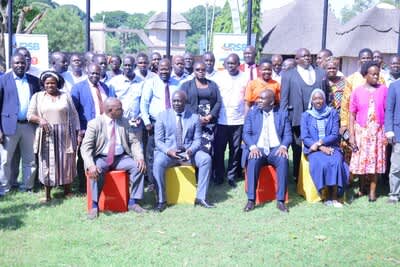
Stakeholders for a group photo during the engagement
By Martin Anguyo
Arua City
The Uganda Registration Services Bureau (URSB) has reaffirmed its commitment to strengthening systems aimed at improving transparency, efficiency, accountability and coordination between government institutions and the private sector through the operationalization of the new Non-Individual Register.
The commitment comes as URSB rolls out its new mandate to establish and maintain a centralized database for all Non-Individual Entities registered, licensed, incorporated, authorized, or operating businesses in Uganda.
The initiative is expected to improve government planning, service delivery, business formalization as well as data sharing among Ministries, Departments, and Agencies (MDAs).
Speaking during a stakeholder engagement meeting held at Dreamland Hotel in Arua District, Alex Anganya, Deputy Registrar General of URSB, described the establishment of the Non-Individual Register as a significant milestone in streamlining the identification, regulation, monitoring, and support of entities operating within the country.
Anganya emphasized that, the initiative is intended to create a more organized and reliable system that will support businesses, organizations, associations, NGOs, and other entities by giving them formal recognition and easier access to government and financial services.
“Formalization is at the heart of this initiative. When entities are formally registered and identifiable, they gain access to opportunities, finance, government services, contracts and markets, where by credibility is built, trust enhanced and enables businesses and organizations to grow sustainably,” he said.
He added that the centralized register will also strengthen inter-agency coordination by enabling different government institutions to access verified and harmonized information about legally recognized entities operating in Uganda.
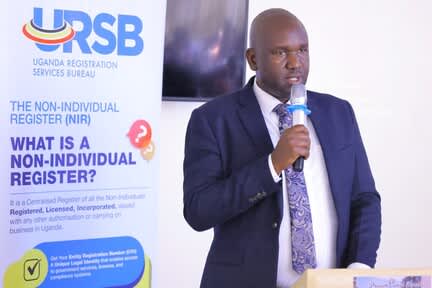
The Arua Resident District Commissioner (RDC), Gore Goffin, welcomed the development and reiterated government’s commitment towards ensuring the successful implementation and operationalization of the Non-Individual Register, calling upon Local Governments, regulatory institutions, the private sector and other stakeholders to work collectively in supporting the initiative so that it achieves its intended objectives.
“With URSB’s continued efforts to improve accessibility and efficiency in registration services, I am confident that this initiative will achieve its intended objectives,” Goffin said.
He further noted that improved coordination and digital registration systems are critical in strengthening compliance, reducing duplication, and enhancing transparency within both public and private institutions.
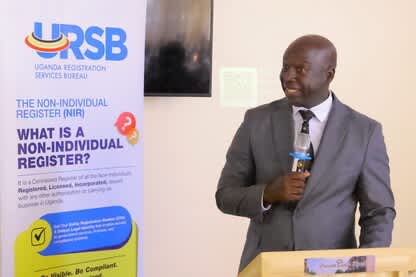
Marion Tugumisirize, a Senior Registration Officer at URSB, explained that the Non-Individual Register will provide a shared digital infrastructure for all MDAs across government, where every registered entity will be issued with a Unique Entity Registration Number (ERN).
According to Tugumisirize, the new system is designed to complement and strengthen existing sector-specific registration systems rather than replace them.
“The Register is intended to support all entity systems in authenticating and verifying legal entities across government platforms. This will improve accuracy, efficiency, and coordination among institutions,” she explained.
She added that the centralized system will help reduce cases of duplication, inconsistencies in entity records, and difficulties faced by businesses seeking services from multiple government agencies.
Stakeholders from the West Nile sub-region who attended the engagement meeting welcomed the initiative, describing it as timely and necessary for improving business operations and government service delivery.
Jenifer Akel, the Acting Commercial Officer for Nebbi District, said the centralized register would help local governments and regulators obtain reliable and updated information on registered entities operating within their jurisdictions.
“The centralized register will make it easier for local governments to access accurate information about businesses and organizations. This will greatly improve monitoring, planning, and service delivery,” Akel noted.
She added that having a unified and verifiable registration system would also strengthen accountability and simplify the work of local authorities involved in regulation and business supervision.
Meanwhile, Silas Anguzu, the Acting Chairperson of the Arua City Chamber of Commerce, observed that many business owners have for years struggled with bureaucratic procedures, fragmented registration systems, and limited coordination among regulatory agencies.
“Many traders and investors have silently struggled with unnecessary delays, repeated documentation requirements, and poor coordination between institutions. We believe this new system can help address some of these longstanding challenges,” Anguzu said.
He expressed optimism that the introduction of the Non-Individual Register and the issuance of Entity Registration Numbers would create a more business-friendly environment and encourage more enterprises to formalize their operations.
The stakeholder engagement formed part of URSB’s nationwide awareness and sensitization campaign aimed at educating government officials, business leaders, civil society organizations, and members of the private sector about the objectives and benefits of the Non-Individual Register.
In 2025, the Government of Uganda, through the Ministry of Finance, Planning and Economic Development, amended the Tax Procedures Code Act to provide for the issuance of an Entity Registration Number (ERN) by URSB after admission onto the Non-Individual Register.
The amendment is expected to strengthen tax administration, improve identification of legal entities, and support government efforts to enhance efficiency in public administration and economic planning.