


Hi, I am Anguzu, Radio Pacis AI Assistant. How can I help you today? Ask me about Radio Pacis, our programmes, frequencies, news, Arua, or the world around us.
19 March 2026 · Radio Pacis Newsroom
Several Traders are still using the outdated weighing scales and others have even abandoned the use of scales. (Credit Photo: Cohen Amvesi) By Dramadri Federick Arua city The Hidden Cost of an Obsolete Law On paper, Uganda’s Weights and Measures Act (Cap 84) w

Several Traders are still using the outdated weighing scales and others have even abandoned the use of scales. (Credit Photo: Cohen Amvesi)
By Dramadri Federick
Arua city
The Hidden Cost of an Obsolete Law
On paper, Uganda’s Weights and Measures Act (Cap 84) was built to protect consumers to ensure that a kilogram is truly a kilogram, and a liter is exactly what it claims to be. But that was 1965.
Nearly six decades later, the law is still standing largely unchanged, while the economy it governs has transformed beyond recognition. Digital weighing scales, electronic fuel pumps, e-commerce platforms, and cross-border trade have replaced the analog systems of the past, yet the law remains rooted in a different era.
The result is a quiet but widespread breakdown in trust, where consumers lose money daily, honest traders struggle to compete and regulators fight a modern battle with outdated tools.
Voices from the Market
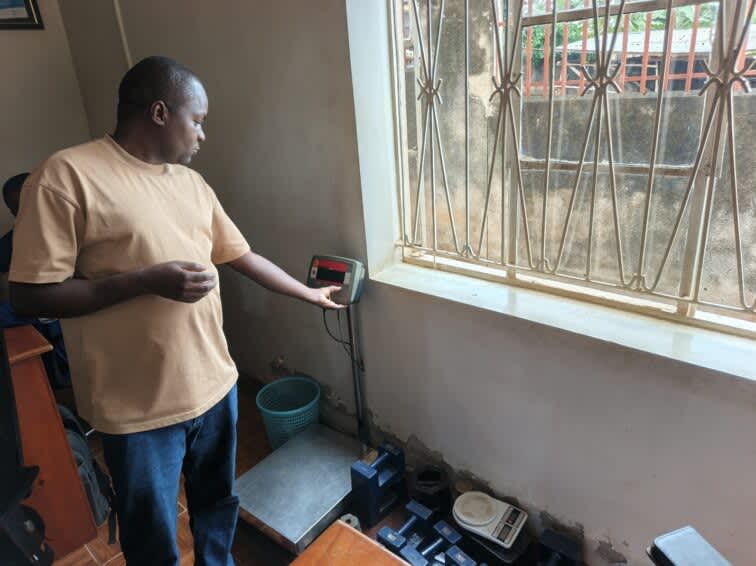
John Kisitu Regional Metrologist at Mbale Regional Testing Laboratory, testing the efficiency of the weighing scales
I met Aletiru (Not her real names because of her request for anonymity), a vegetable vendor in Arua City’s bustling Arua Main Market. She uses an old, worn-out spring balance scale to weigh tomatoes and onions. She explains that the scale has become a burden as she can’t sell items using it because the customers continuously complain of it.
“Sometimes customers complain. I bought a new weighing scale and I found it was a fake one I had to leave, but what can I do? New scales are expensive, and inspections are rare,” Aletiru confides.
This is representative of how many small traders rely on outdated weighing equipment that often lacks legal verification stamps mandated by law.
Uganda’s Weights and Measures Act was enacted in 1965, in it, provisions, such as Sections 13 -16, prohibit the use of unstamped or unlawful measuring devices. But its penalties tell a different story. A first-time offender can be fined as little as 500 Ugandan shillings a figure so outdated that it has lost all practical deterrent value.
The Law was built for a different economy one defined by manual tools, local trade, and limited technological complexity compared to the current state of affairs in trade.
Back then, mechanical scales, measuring tins, and analog fuel pumps dominated commerce, but today, Uganda’s economy has evolved into a digitized, regionally integrated system. Electronic scales, computerized fuel pumps, and cross-border trade are the norm. Yet the law has not kept pace with the changes.
On the consumer side, John Amati, a bodaboda rider and frequent fuel buyer, reports inconsistent fuel dispensing during purchases.
“You pay 5,000 shillings or sometimes 5,500 shillings for a liter, but the pump often gives you less. Few complain because the law isn’t clear or enforced. For me, I have resorted to buying fuel from the roadside sellers who can clearly measure a litre using the containers and you verify immediately and they sell slightly cheaper than those in petrol stations” he laments.
“Indeed, the current legal framework inadequately regulates electronic fuel pumps, failing to keep pace with technology” he added.
Arua main Market Vendors Association Chairman Herbert Odama Reveals that out of the 1,563 registered Vendors in the Market only about 20% have certified and stamped weighing scales. “Majority of the vendors are not using these scales because they feel they don’t make a lot of sales and profits. Others subject them for verification and they don’t use the stamped ones they have others that they use instead. The challenge is UNBS doesn’t frequent the market, they come either once or twice a year,” Odama stated.
Consumers Paying the Hidden Price
For consumers, the consequences are immediate and cumulative.
Arua based Economist, Auditor Godfrey Anguyo reveals that he bought 32 bags of 50kilograms cement from a wholesale shop each at 35,000 shillings, but found the bags weighed between 40-45kgs. He noted that even when he complained the sellers paid deaf ears claiming that these were brought by their suppliers, “I can’t imagine that all that money was gone, I realized that these business people remove some kilos for their excess profits, they gave me a general receipt of acknowledgement which was not a headed receipt without trader details. The law is not helping us a tall,” Anguyo stated bitterly.
Investigations by the Uganda National Bureau of Standards (UNBS) reveal that underweighting in pre-packaged goods such as sugar and rice ranges between 50g and 150g per kilogram. That translates into a hidden “tax” of 5% to 15% per purchase.
“When you multiply that across millions of transactions every day, it becomes a massive transfer of wealth from consumers to dishonest traders,” explains the economist. “It’s not just petty fraud, it’s systemic economic leakage.”
UNBS surveys further indicate that 58% of sampled products in open markets fail at least one quality or measurement parameter. In many cases, traders use illegal spring balances tools intended for personal, not commercial, use.
Traders in a Broken System
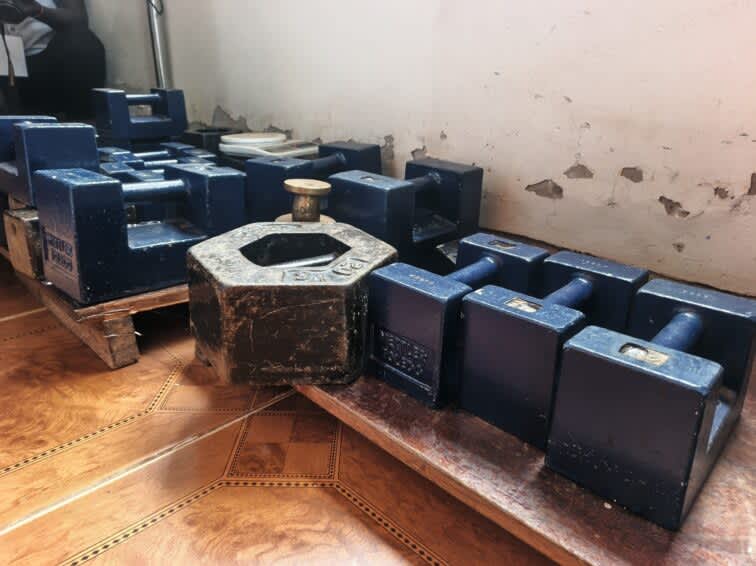
Confiscated fake Weighing scales at Mbale Regional Metrology Department (Photo by: Dramadri Federick)
Not all traders are acting in bad faith.
A shop owner in Arua, who asked not to be named, says the lack of clear, updated regulations creates confusion. “Some of us want to comply,” he explains, “but the system is not clear about modern equipment. What standards apply to digital scales? Who certifies them?”
He adds that enforcement is inconsistent. “You might follow the rules, but your competitor uses a fake scale and undercuts your prices. The penalty is so small, it doesn’t matter.”
This uneven playing field punishes honest businesses while rewarding those willing to exploit regulatory gaps.
Regulatory challenges

One of the Vendors with Verified, stamped weighing scales at Carnegie-A market in Arua City (Photo by: Dramadri Federick).
Oversight of measurement standards falls to UNBS, particularly its Legal Metrology Department. The agency acknowledges the scale of the problem.
In the 2024/25 financial year, UNBS verified just over 282,000 pieces of measurement equipment far short of its 1.6 million target. At the same time, more than 2,000 fake weighing scales were discovered across the country.
UNBS also seized approximately 1,265 tons of substandard goods during that period. While this marks a decrease from the previous year’s 11,177 tons, officials warn it may reflect limited enforcement capacity rather than improved compliance.
John Kisitu the Mbale Regional Metrologist who doubles as the In-charge Mbale Regional Laboratory established by UNBS revealed that the changing technology has caught the law off guard.
“We are dealing with an increasingly complex market using a law designed for a simpler time,” Kisitu notes. “Digital systems, e-commerce, and smart metering are not explicitly covered. That creates enforcement challenges.”
Legal Gaps in a Digital Economy
Legal analysts note that statutory penalties under the Act are outdated and insufficiently deterrent. Initial offences may incur fines as low as 500 Ugandan shillings, that are mere cents today with repeat violations facing equally minimal consequences, undermining enforcement efficacy.
For legal experts, the issue is clear that the law is structurally outdated as it has failed to capture the evolving technology.
Lawyer, Fred Abibo Arowa states, “Such nominal fines serve only as a minor inconvenience. Businesses often weigh the risk and find non-compliance cheaper than adherence.”

Lawyer Abibo Fred Arowa explains that the law needs an immediate amendment as of Yesterday.
Abibo the Arua-based lawyer and Managing Partner of Sinai Associates and Partners points out that the Act does not address e-commerce, software-calibrated devices, or cyber security risks in measurement systems. “We are applying analog rules to a digital marketplace. That leaves too much room for interpretation and exploitation. Even the penalties for serious violations remain weak. Repeat offenders face fines of up to 5,000 shillings or short-term imprisonment of not more than 6 months, but only if convicted within five years of a previous offence,” Abibo says.
“In real terms, these penalties are negligible. They fail to deter non-compliance, especially when the financial gains from cheating can be substantial. The law even requires the enforcement officer to negotiate with the trader on whether to check his machine or not,” the lawyer adds.
The Regional Trade Risk
Uganda’s membership in the East African Community raises the stakes further. Regional trade depends on harmonized standards. When Ugandan exports are flagged for inconsistent measurements, exporters must pay for full re-verification at the destination costing between $200 and $500 per shipment. These delays and added costs erode competitiveness. Estimates suggest Uganda loses between $10 million and $20 million annually in potential trade due to concerns about measurement reliability according to UNBS.
Economist Dr. Samuel Kato emphasizes, “Measurement integrity underpins market fairness and trade competitiveness. Persistent violations erode consumer trust locally and jeopardize Uganda’s compliance with East African Community trade standards,” the economist stated
Beyond trade losses, the economic impact is widespread. The value of goods destroyed annually due to non-compliance is estimated between UGX 3 billion and UGX 6 billion.
At the same time, efforts to modernize the law through proposed bills and amendments have yet to produce results. UNBS is working with the Uganda Law Reform Commission to review the legislation, but progress has been slow, hindered by limited political will and low stakeholder awareness.
Paparu Lillian Obiale the Woman Member of Parliament for Arua district and a Member of the Finance committee of 11th Parliament says much as a request for the amendment of the Weights and Measures Act Cap 84 has not been tendered before the committee or even parliament, the Weights and Measures Act is one of the laws coopted from the colonialists and truly its needs to be amended. “Once the Parliamentary Council that drafts laws come up with such requests, we are ready to support because the matter affects us directly as consumers and vendors,” the MP stated.

Hon. Paparu Lillian Obiale is optimistic that such laws must be amended
A System at a Crossroads
The central question remains: Has the law failed to keep pace with economic and technological change? The evidence suggests it has. Consumers bear the cost through hidden losses. Honest traders face unfair competition. Regulators struggle with outdated tools. Lawyers warn of legal blind spots. Economists point to systemic inefficiencies and lost national revenue.
What emerges is not just a story of an old law but of a modern economy constrained by it. As Uganda continues to integrate into regional and global markets, the urgency for reform grows sharper. Without it, the simple act of buying a kilogram of sugar or a liter of fuel will remain a question of trust rather than certainty.