


Hi, I am Anguzu, Radio Pacis AI Assistant. How can I help you today? Ask me about Radio Pacis, our programmes, frequencies, news, Arua, or the world around us.
18 July 2026 · Radio Pacis Newsroom
Minister for Local Government Balaam Barugahara measuring a newly constructed bridge in Bulambuli District (Courtesy Photo) By Dramadri Federick Arua City The nationwide anti-corruption campaign led by the Minister for Local Government, Balaam Barugahara, has
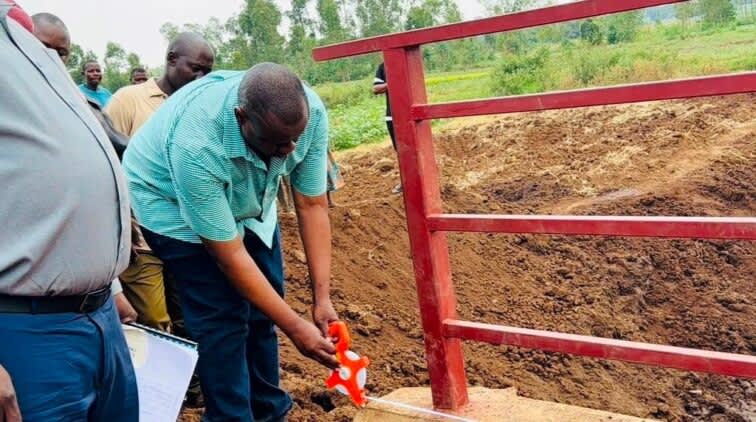
Minister for Local Government Balaam Barugahara measuring a newly constructed bridge in Bulambuli District (Courtesy Photo)
By Dramadri Federick
Arua City
The nationwide anti-corruption campaign led by the Minister for Local Government, Balaam Barugahara, has ignited a national debate over his aggressive enforcement tactics, with supporters praising his determination to tackle corruption while critics questioning the legality and professionalism of his methods.
In recent weeks, the minister has conducted surprise inspections of government-funded projects across districts in eastern Uganda, carried out public headcounts of local government officials, and ordered the immediate arrest of suspected officials during field visits.
The approach has attracted widespread public attention and generated mixed reactions from professional bodies, civil society organisations, and political leaders.
The Uganda Institution of Professional Engineers (UIPE) has strongly criticized the arrest of municipal and district engineers without prior technical investigations in its letter dated July 11, 2026.
The association argues that allegations of project failures should first undergo technical audits, structural assessments, and established administrative disciplinary processes before criminal proceedings are initiated.
The criticism follows Barugahara’s inspection in Bulambuli District, where he ordered the arrest of engineers and town clerks after discovering that a 500 million Shillings bridge project reportedly consisted only of heaps of soil dumped at the wrong location. He also cited a 73 million shillings public toilet that had allegedly been constructed without an underground pit.
Despite the criticism, Barugahara has defended his actions, insisting that he will not be intimidated by individuals or institutions as he pursues what he describes as a determined campaign against corruption in local governments.
“Some people have been asking me why I am inspecting schools, hospitals and roads. I want to clarify that all these sectors are under local governments, and I have to inspect works implemented using funds channeled through local governments. This campaign will continue across all the 156 local governments in the country. Monitoring means taking measurements. I move with a tape measure to verify construction works and conduct physical headcounts of staff and learners in public institutions to establish value for Money.”
The minister added: “The only way to get facts from the public is by arresting the person who may intimidate them from giving evidence. We arrest you to contain the situation, obtain the information and, where necessary, charge you. Whatever we are doing is within the law.”
Public opinion, however, remains divided.
Arua City Deputy Resident City Commissioner for Ayivu Division, Mbigiti Godfrey Jonah, commended the minister’s approach, saying it demonstrates commitment and genuine resolve to combat corruption. “If a minister can come and discover something like a toilet worth 73 million shillings, yet there are officers responsible for monitoring such projects, then he is doing the right thing. We needed a person of Balaam’s caliber to wake us up,” Jonah said.
However, veteran politician Wadri Kasiano Ezati questioned the motive behind the campaign, arguing that it appears more aimed at impressing the appointing authority than strengthening accountability institutions.
“I think if we are to fight corruption, we should strengthen institutions and not a Minister running up and down arresting technocrats without due processes”, Wadri said.
On the other hand, Ernest Enzama, Executive Director of the Mayang Anti-Corruption Coalition (MAACO), said Barugahara’s interventions should complement, rather than replace, the work of constitutionally mandated anti-corruption agencies such as the Inspectorate of Government and the Office of the Director of Public Prosecutions.
“He has demonstrated active leadership in the fight against corruption. The question now is how many people are willing to join him in that fight,” Enzama said.
According to the Inspectorate of Government (IGG), corruption costs Uganda between UGX 9.1 trillion and UGX 10 trillion every year equivalent to nearly 23 percent of the national budget.
The losses arise from bribery, embezzlement, procurement fraud, payroll irregularities, and abuse of public office, significantly undermining public service delivery and slowing national development.