


Hi, I am Anguzu, Radio Pacis AI Assistant. How can I help you today? Ask me about Radio Pacis, our programmes, frequencies, news, Arua, or the world around us.
19 September 2025 · Radio Pacis Newsroom

Some of the packaged products ready for distribution from Arua City Value Addition Facility By Dramadri FederickArua City Farmers in the West Nile region now have a reason to smile following the full operationalization of the Arua City value addition facility.
Some of the packaged products ready for distribution from Arua City Value Addition Facility
By Dramadri Federick
Arua City
Farmers in the West Nile region now have a reason to smile following the full operationalization of the Arua City value addition facility. The facility, managed by Rwahi Investments Limited, faced several challenges in its early stages including inadequate raw materials, community attitudes and political intrigue, which rendered it underutilized and temporarily non-functional.
The 8 billion shilling facility, located in Chongoliya cell, Awindiri ward in Arua City, is a key component of the Shs. 34.9 billion African Development Bank-funded Arua Central Market Project, under the Market and Agriculture Trade Improvement Program (MATIP-II).
It was commissioned by H.E. Yoweri Kaguta Museveni in October 2020 with the primary aim of empowering farmers in the West Nile region to add value to their cereals and sell them at higher prices.
Joel Arumadri, a farmer from Madi Okollo district, who brought his maize for processing into flour noted that, the process is less time-consuming and more cost-effective.
Despite transportation challenges faced by farmers, the added value allowed him to double his profits. "I brought one ton of maize and was able to go back with 800 kg, which fetched UGX 1,760,000 Shillings. The maize without processing would not have reached UGX 1 million. I thank the government for establishing this facility here," Arumadri revealed.
Currently, the facility processes up to 50 tons of maize per day, with an average output of 26–30 tons. This places pressure on local governments to support cereal farmers across the region.
Fred Tabu, the Deputy Speaker of Arua City noted that, many people in the region are not fully aware of the existence or importance of the value addition facility. He emphasized that understanding and utilizing its potential can enhance market linkages and economic benefits. “We need to empower our people with the right knowledge on crop production and ensure they get value for their efforts. Many of our farmers don't have enough information about this initiative,” he said.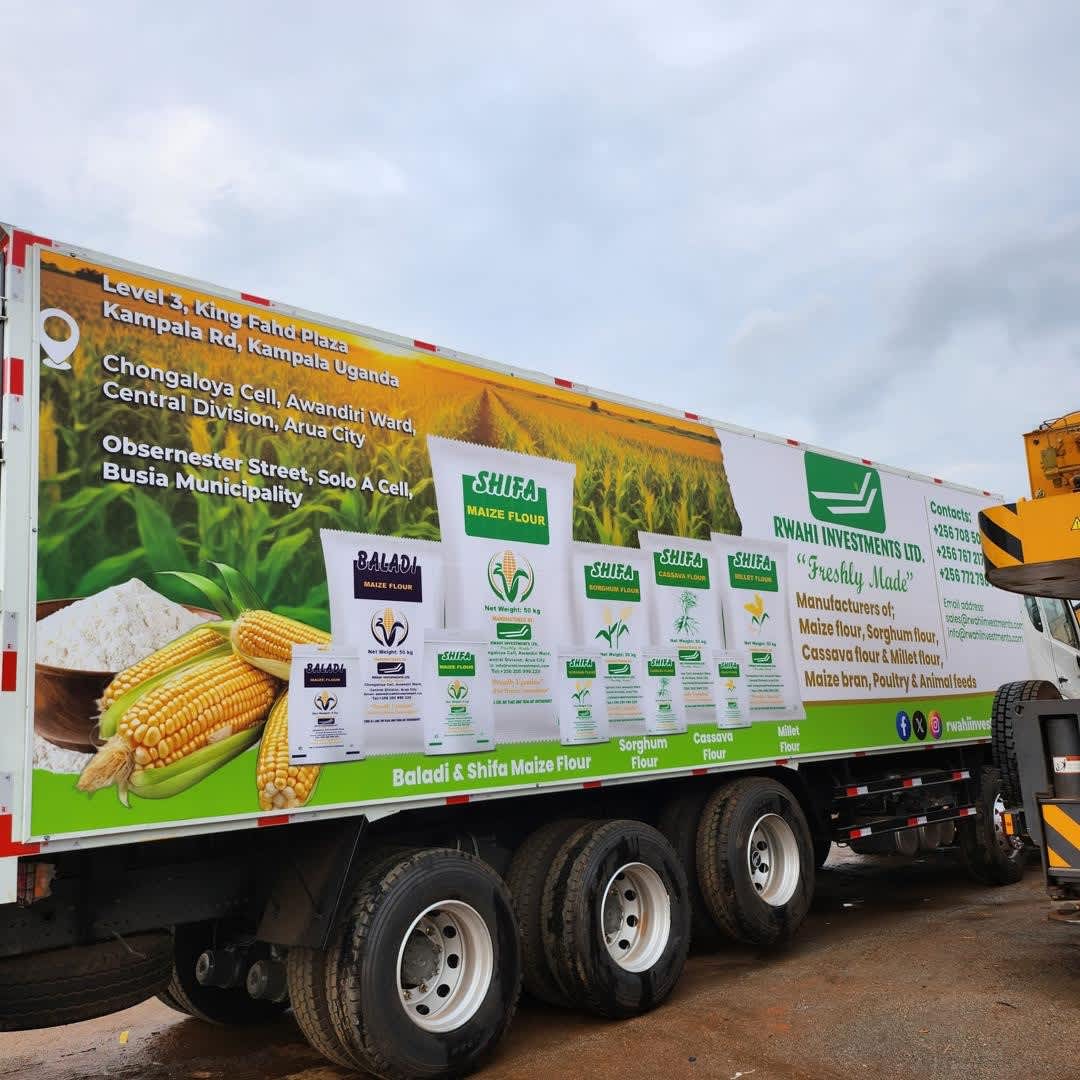
The Company’s Marketing Vehicle for distributing the Value Added products from Arua Value Addition
Facility to the Retailers and other Whole sellers.
According to the company records, for a local farmer within West Nile to qualify for product processing, they must produce at least 3 tons (3,000 kgs) of produce.
Reacting to this requirement, Hon. Jackson Atima Lee Buti, the Member of Parliament for Arua Central Division appealed to the company to consider the realities faced by local farmers, highlighting that, many small-scale farmers cannot produce more than one ton at a time despite having land capable of producing over 10 tons in a season. “I urge the company to consider the circumstances of our farmers who willingly gave land after observing the challenges they face. This can only happen if farmers are organized into groups to produce in bulk,” Atima said in an interview.
Joseph Olupot, the General Manager of Rwahi Investments Limited explained that, their operations are majorly affected by fluctuations in raw material availability.
He announced that the facility is now operating at full capacity, engaging in branding and distribution that serve regional markets in West Nile, as well as export markets in the Democratic Republic of Congo and South Sudan. “Our main challenge is not power supply as it used to be. We currently produce more than what Arua main markets can consumes. On a daily basis, we supply between 7 and 8 tons of products, selling at wholesale prices of UGX 2,200 per kg for first-class posho and UGX 2,000 for second-class,” Olupot said.
He encouraged farmers in the West Nile region to adopt cooperative farming to produce in bulk, which can lead to increased income levels.
Most cereals in the facility are sourced from the Democratic Republic of Congo, with others coming from the Lango, Acholi, and Teso sub regions of Uganda.
Jobel Ayiko, the Acting Commercial Officer of Arua City, revealed that government plans are underway to increase the production of high-value crops such as maize, sorghum, and millet, which are in demand in international markets.
Ayiko urged farmers who benefited from the Parish Development Model (PDM) and the Emyooga program to invest in these crops, as their markets are readily available. “As commercial officers, our role is to identify successful enterprises under PDM and guide farmers toward the right high-value crops to improve their income,” he mentioned.
The value addition center has a capacity of 500 metric tons and can mill up to 1,000 bags of various crops per day when operating at full capacity. It is designed to operate for more than 30 years with routine maintenance and operational support.