
Hi, I am Anguzu, Radio Pacis AI Assistant. How can I help you today? Ask me about Radio Pacis, our programmes, frequencies, news, Arua, or the world around us.
30 June 2026 · Radio Pacis Newsroom
The Chairperson Pakwach district Persons with Disabilities (PWDs) receiving a solar panel and accessories from James Namoma, the Resident City Commissioner in charge of Arua Central Division in the presence of Robert Ssewagudde (PWD national MP) By Dramadri Fe
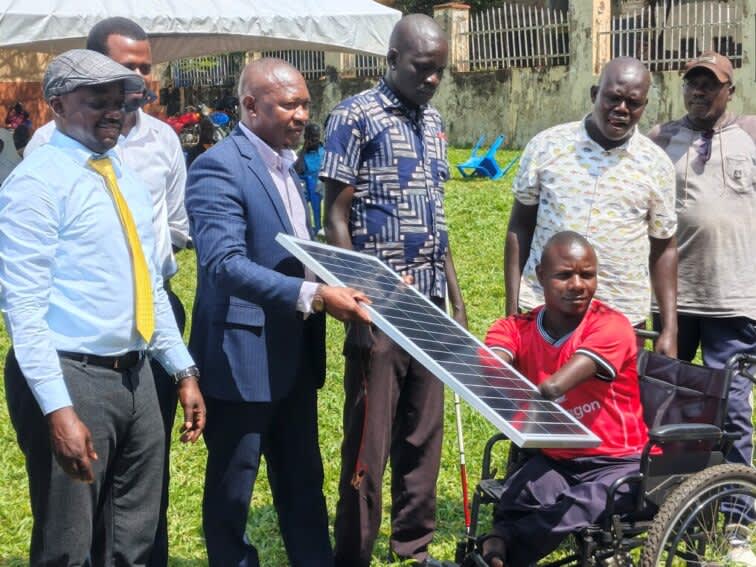
The Chairperson Pakwach district Persons with Disabilities (PWDs) receiving a solar panel and accessories from James Namoma, the Resident City Commissioner in charge of Arua Central Division in the presence of Robert Ssewagudde (PWD national MP)
By Dramadri Federick
Arua City
The National Member of Parliament representing Persons with Disabilities (PWDs), Robert Ssewagudde, has called on the government to fast-track electricity connectivity and expand access to household levels in the West Nile Sub-region, saying reliable power supply is critical for economic transformation and improved livelihoods.
Ssewagudde made the appeal during the handover of 70 sets of solar panels and accessories to leaders of Persons with Disabilities from the 13 local governments across West Nile.
He said that although West Nile is connected to the national electricity grid, many communities’ especially rural households and persons with disabilities continue to live without reliable access to electricity, limiting their ability to engage in productive activities, access information, and improve their standards of living.
Ssewagudde, who recently visited parts of Moyo and Obongi districts, said the level of darkness experienced in some communities demonstrates the urgent need for government intervention in rural electrification.
“In particular, Moyo and Obongi districts where I went, I found total darkness at night. It made me understand the depth of the challenges related to electricity affecting persons with disabilities in West Nile. At night, we could not see anything. It was total darkness, and I think government should up its game in rural electrification in the region,” Ssewagudde said.
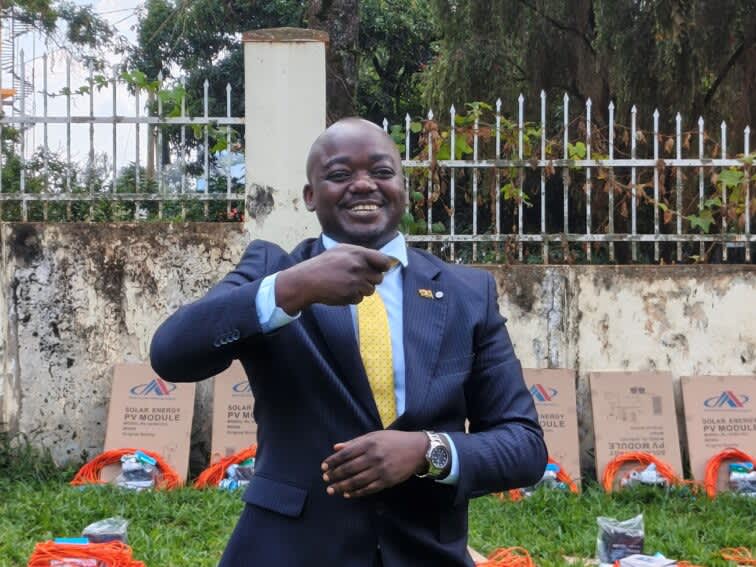
PWD national MP, Robert Ssewagudde (with hearing Impairment) delivering his speech
He explained that persons with disabilities face additional challenges due to limited access to lighting, which affects their businesses, security, mobility, and access to essential services.
The West Nile sub-region was officially connected to the Ugandan national electricity grid on August 3, 2024. President Yoweri Museveni commissioned the 132kV Kole-Gulu-Nebbi-Arua transmission line at the Nebbi Substation, marking the end of decades of erratic power supply from localized thermal and isolated hydro plants. However several districts including Obongi, Moyo and Adjumani have not tapped this electricity affecting productivity and eventual development.
Michael Didi Paul, the District Councillor for Persons with Disabilities in Obongi District and District Speaker, said communities in Obongi have not witnessed meaningful electricity expansion since the district was created.
He noted that the absence of electricity infrastructure such as poles, cables, and transformers has slowed development and affected residents’ ability to participate in economic activities.
“The lighting system is a nightmare in most districts in West Nile, particularly Obongi, which has not seen any electricity poles, cables, among other infrastructure. This is affecting development growth in the region,” Didi said.
Didi added that poor electricity access has affected small businesses, education, and service delivery, leaving many communities dependent on alternative energy sources that are often expensive and unreliable.
Meanwhile, Elio Beatrice, Chairperson of the Women’s League in Moyo District, said inconsistent electricity supply has negatively affected children’s education, as many learners struggle to study at night.
She said the solar equipment provided will help bridge the electricity gap in homes and support learners who require lighting for evening studies.
“Our electricity is not always efficient; it keeps going on and off. This solar system will bridge that gap in our homes and also help our learners,” Elio said.
However, James Namoma, the Arua Deputy Resident City Commissioner in charge of Arua Central Division, pledged continued government support towards improving the welfare of persons with disabilities and addressing gaps in service delivery.
Namoma said ongoing rural electrification initiatives are expected to improve electricity access in underserved communities and promote inclusive development.
“It was an oversight where past governments did not recognize the value within persons with disabilities, but the current government is advocating for inclusivity and equity in service delivery,” Namoma said.
According to the Ministry of Energy and Mineral Development, electricity access in the West Nile Sub-region remains among the lowest in the country, with only about four percent of the population mainly concentrated in urban areas connected to electricity.
Stakeholders argue that increasing electricity access to rural households would not only improve living conditions but also stimulate small businesses, enhance education outcomes, improve healthcare services, and create opportunities for persons with disabilities to participate fully in economic activities.