

Hi, I am Anguzu, Radio Pacis AI Assistant. How can I help you today? Ask me about Radio Pacis, our programmes, frequencies, news, Arua, or the world around us.
13 July 2026 · Radio Pacis Newsroom
Catholic school heads pose for a group photo with Archbishop Raphael P’Mony Wokorach after their meeting at Uganda Martyrs Major Seminary, Alokolum. By Proscovia Achomo Gulu City The Archbishop of Gulu Archdiocese, Most Rev. Raphael P’Mony Wokorach, has called
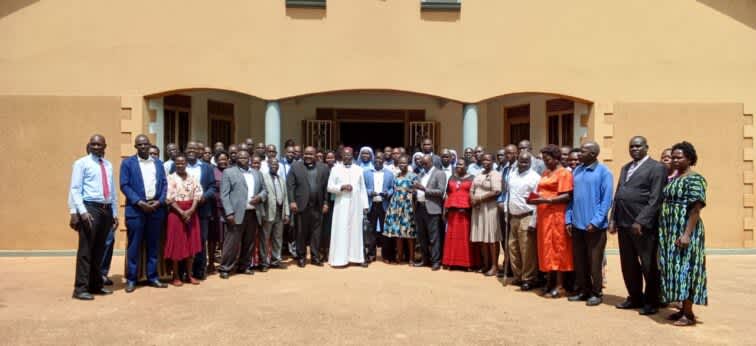
Catholic school heads pose for a group photo with Archbishop Raphael P’Mony Wokorach after their meeting at Uganda Martyrs Major Seminary, Alokolum.
By Proscovia Achomo
Gulu City
The Archbishop of Gulu Archdiocese, Most Rev. Raphael P’Mony Wokorach, has called on heads of Catholic schools to strengthen and safeguard the Catholic identity of their institutions by placing faith, Church teachings, and Gospel values at the centre of school life.
Speaking during a meeting with Catholic school leaders, Archbishop Wokorach emphasized that Catholic schools should visibly reflect their religious identity through prayer, moral formation, liturgical celebrations, and the display of religious symbols.
He urged school administrators to ensure that crucifixes, portraits of the Pope and the local bishop, and other Catholic symbols are prominently displayed as a testimony to the schools’ mission.
The Archbishop also stressed the importance of teachers actively participating in prayer and worship alongside learners. “Prayer with children is vital. When schools attend Mass in the parish, teachers should accompany their learners because when children see their teachers praying, they are encouraged to deepen their own faith,” he said.
Lucy Abwot, Head teacher of Atanga Girls Secondary School, welcomed the Archbishop’s call but noted that many schools struggle to obtain the religious materials needed to reinforce their Catholic identity.
She appealed to the Archdiocese to make such items more accessible by distributing them through parishes, where schools could easily procure them. “School heads are willing to promote Catholic identity, but it is not easy to access these items. We have requested that, where possible, they be made available through our parishes so schools can obtain them,” Abwot said.
While school leaders recognize the importance of creating learning environments that reflect Catholic values, some say the cost of acquiring religious materials remains a major challenge, particularly for schools operating with limited resources.
Francis Akera, Deputy Headteacher of Paicho Secondary School, said many of the items required to strengthen Catholic identity are costly and beyond the reach of some institutions.
Responding to these concerns, the Association of Catholic Educational Institutions (ACEI) said it is working towards a long-term solution.
The association’s Secretary for Publicity, Julius Nyerere, revealed that ACEI plans to establish centres in both the Gulu and Kitgum vicariates where Catholic school leaders can conveniently access religious items and other materials needed to strengthen the Catholic identity of their institutions. He said the centres will make it easier for schools to obtain crucifixes, portraits of the Pope and the local bishop, liturgical materials, and other resources necessary to preserve and promote Catholic identity within their institutions.
According to Aldo Kidega of Kitgum Technical Institute, some school structures and practices are gradually drifting away from the Catholic foundation upon which the institutions were established.
Kidega noted that Catholic missionaries played a significant role in introducing formal education in Uganda by constructing schools before later handing them over to communities and the government for management and support. He said the schools were originally designed according to distinctive Catholic architectural and institutional standards, but many have lost that identity over time, particularly during renovations.
“Education was introduced by Catholic missionaries in Uganda. They built the schools and later handed them over to the government to support and manage. These schools were designed according to Catholic standards, but over time, especially during renovations, many of the original designs have been altered. We should preserve those architectural designs and restore the identity of Catholic-founded schools as they were originally constructed,” Kidega said.
Fr. Lazar Arasu, SDB, Headteacher of Don Bosco Secondary School, called for continuous formation and training of Catholic school heads, teachers, and managers to deepen their understanding of Catholic identity and leadership.
He observed that gaps remain in the faith formation of many educators, including participation in the sacraments and their ability to guide learners in living out Catholic values. “There is a need for ongoing formation of school heads, teachers, and managers on Catholic identity. We must ask ourselves how many teachers are practicing their faith, participating in the sacraments, and effectively reaching out to children. Catholic identity must be nurtured through leadership at every level,” Fr. Arasu said.
The Archbishop’s call comes as the Gulu Archdiocese continues to oversee an extensive network of Catholic educational institutions. The Archdiocese currently manages 637 schools, underscoring the Church’s significant contribution to education in the region. These institutions continue to provide quality academic formation while promoting discipline, moral values, spiritual growth, and a culture of service among learners.