


Hi, I am Anguzu, Radio Pacis AI Assistant. How can I help you today? Ask me about Radio Pacis, our programmes, frequencies, news, Arua, or the world around us.
16 June 2026 · Radio Pacis Newsroom
Stakeholders from the two countries and representative of partners pose for a group photo at Dissa in DRC (Photo by Martin Anguyo) By Martin Anguyo Arua City As Uganda and the Democratic Republic of Congo (DRC) battle a resurgence of the deadly Ebola Virus Dis
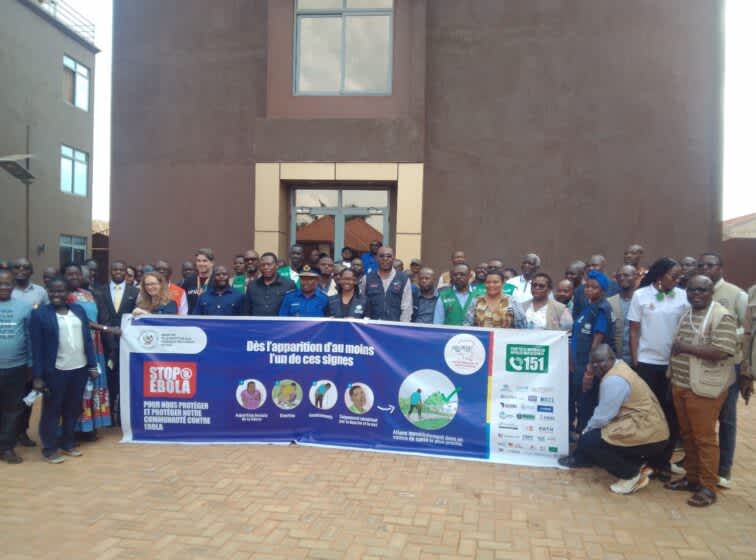
Stakeholders from the two countries and representative of partners pose for a group photo at Dissa in DRC (Photo by Martin Anguyo)
By Martin Anguyo
Arua City
As Uganda and the Democratic Republic of Congo (DRC) battle a resurgence of the deadly Ebola Virus Disease (EVD), health experts and development partners are sounding the alarm over what they describe as growing political interference and complacency that could jeopardize efforts to contain the outbreak.
The warning emerged from a two-day bilateral meeting on Ebola preparedness and response held over the weekend at Dissa Hotel in Ituri Territory, eastern DRC. The meeting brought together health officials, epidemic response experts, development partners, and government representatives from both countries amid increasing concerns over the spread of the highly infectious disease.
Participants stressed that while both countries have made significant investments in disease surveillance and emergency response systems over the years, those gains could easily be reversed if leaders fail to prioritize public health over politics.
Health experts noted that some political leaders have begun treating Ebola as a political issue rather than a public health emergency, a trend they warned could weaken public confidence, fuel misinformation, and reduce community cooperation in outbreak response efforts.
“Ebola does not recognize borders, political affiliations, or national interests,” one participant remarked during the discussions. “Any attempt to politicize the response only creates opportunities for the virus to spread.”
Professor YAP Boum II, Regional Epidemic Coordinator for the Africa Centres for Disease Control and Prevention (Africa CDC) in the DRC, emphasized that the success of the Ebola response depends heavily on cooperation between neighboring countries.
“The DRC share extensive and highly porous borders that facilitate daily movement of traders, refugees, and local communities, making collaboration in surveillance, contact tracing, and information sharing indispensable. The virus moves faster than bureaucracy, I urge authorities to strengthen coordination and maintain open channels of communication across border districts” he said.
The World Health Organization’s Regional Director for Health Emergencies in Africa, Dr. Marie Roseline Darnycka Bélizaire, echoed similar concerns, warning that fragmented efforts could undermine the progress achieved so far.
She noted that Ebola outbreaks thrive in environments where fear, mistrust, and misinformation take root, making community engagement just as important as medical interventions.
“Governments, health workers, religious leaders, and local communities must work together to ensure that prevention messages reach the grassroots and that suspected cases are identified and managed promptly. Without unity and collective action, all our efforts risk becoming ineffective,” she warned.
Uganda’s Director General of Health Services, Prof. Charles Olaro, challenged health officials in both countries to place communities at the center of every response strategy.
“Communities are often the first line of defense against infectious diseases and should never be treated merely as recipients of information. Residents should be active participants in surveillance, reporting suspected cases, promoting safe health practices, and combating misinformation” he said.
Uganda has so far registered 19 confirmed Ebola cases, while the Democratic Republic of Congo has reported 689 cases, underscoring the magnitude of the challenge facing health authorities in the region.
The figures have heightened concerns among health partners, particularly because the two countries share one of Africa’s busiest border corridors. Thousands of people cross between the two nations daily for trade, employment, family visits, and humanitarian reasons.
Meanwhile, Dr. Christine, speaking on behalf of development partners, advised political leaders to avoid statements or actions that may create confusion among the public.
“Leaders have a responsibility to champion scientific evidence and support health professionals instead of sending mixed messages that could discourage people from seeking medical assistance” she said.
As the meeting concluded, delegates reaffirmed their commitment to strengthening regional cooperation against Ebola. However, experts cautioned that declarations alone will not stop the virus.
The real test, they said, lies in whether governments can translate commitments into action by investing in surveillance, supporting frontline health workers, empowering communities, and keeping politics out of a fight that is ultimately about saving lives.