


Hi, I am Anguzu, Radio Pacis AI Assistant. How can I help you today? Ask me about Radio Pacis, our programmes, frequencies, news, Arua, or the world around us.
20 July 2026 · Radio Pacis Newsroom
Improved Robusta coffee clones growing at Kawacom Mother Garden in Kweyo Village, Koro Sub County in Omoro district. Photo by Richard Odong. By Odong Richard Gulu City The agricultural economy in Northern Uganda continues to positively respond to opportunities
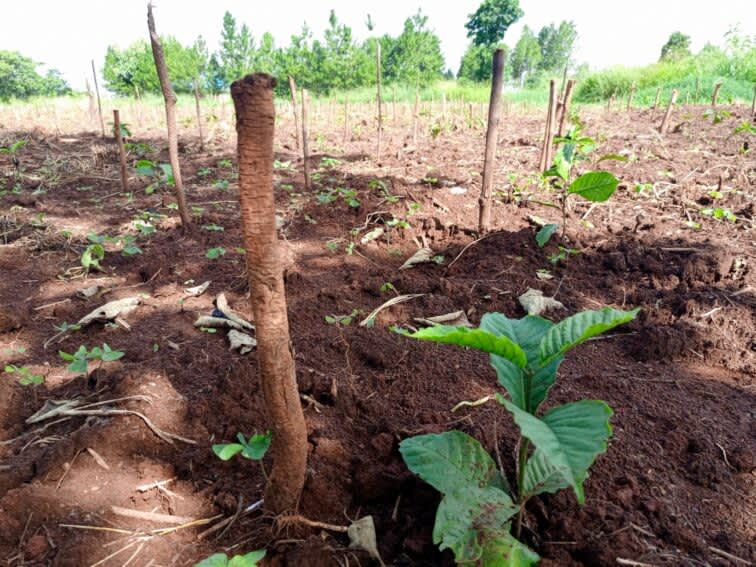
Improved Robusta coffee clones growing at Kawacom Mother Garden in Kweyo Village, Koro Sub County in Omoro district. Photo by Richard Odong.
By Odong Richard
Gulu City
The agricultural economy in Northern Uganda continues to positively respond to opportunities presented by the frantic search for viable means to build climate resilience alongside adaptations and mitigations efforts around the globe.
This is being made possible through the integration of several climate change adaption technologies such as solar driers for crop farmers, improved and high yielding crops which are fast maturing as well as varieties tolerant to sudden changes in weather patterns. The other is the remarkable improvement in climate change understanding amongst farmers.
Many of them now know that the nature of each rainfall season determines its outcomes in terms of productivity. To be more successful, farmers lace adoption of smart climate technologies with the right attitude, informed choices and timely actions as advised by environmental and climate experts.
In an environment witnessing change, yet characterized by poor existence of early warning systems, inert absence of functional weather stations or ill developed agriculture insurance services for small scale and the large-scale farmers alike, achieving success in farming in Northern Uganda now depends on timing and quality of rainfall as well as the crop technology a farmer choses to produce.
Climate models of the Ministry of Water and the Environment, published in different reports between 2020 and 2024 have put average temperature increase in the region at 0.8 degrees Celsius over the last three decades, significant enough to disorganize the rainfall pattern in the region. Water stresses are projected to increase as tree covers shrink. Soil fertility is now known to be on decline in most areas as well as the number of cold and hot days shift upwards.
Stories of seasonal crops failing in the field are increasing as household incomes are reducing year-on-year. Poverty burdens remain stagnant. In the heat of the moment, several crop technologies have been introduced to the Northern Uganda agroecological zone by government and the private sector in view of building the resilience of the population against climate crisis. From cereals to tubers, birds to large ruminants, the North is now a hotbed of scientific research – all aimed at reducing the impacts of shocks to Climate Change.
Among the productive technologies, Coffee has been flagged as the ultimate insurance capable of withstanding the worst of seasons despite being considered historically alien to the Northern Uganda agroecological zone. Pioneer farmers growing the crop say their household economies are stronger and more resilient against climate hazards.
Enterprising Farmers
In the 1960s, colonial agronomists laid a strong caveat over Northern Uganda by declaring it unfit for Coffee growing. The declaration condemned the region to a single cash crop: Cotton, whose market collapsed many years ago. Five years ago, some enterprising farmers began a quest for a new market-oriented agro-industry in the region. An industry built on Coffee, the global Green Gold.
Among these pioneers is Alfred Oyet, a Coffee Entrepreneur in Gulu City and farmer in Pawel village, Amuru District. Oyet decided to venture into Coffee growing in Northern Uganda at a time when many people considered the enterprise unviable in the region to invest their multimillion shillings. He began experimenting his passion with five straight acres of land under coffee.
Oyet is now more than a coffee farmer, buyer, processor and retailer. He is an exporter as well. Three years later, he began picking his beans for processing while skeptics were singing from a book of poems composed using stanzas of many myths. Lush green and agile, coffee branches pronounced hopes and meaningful changes in his fields.
“The first set of harvests I achieved ministered a different gospel to those who saw them. Some people immediately offered to work for me while others asked for seedlings to plant in their own gardens.” Oyet narrated as he inspected his green coffee cherries during this interview.
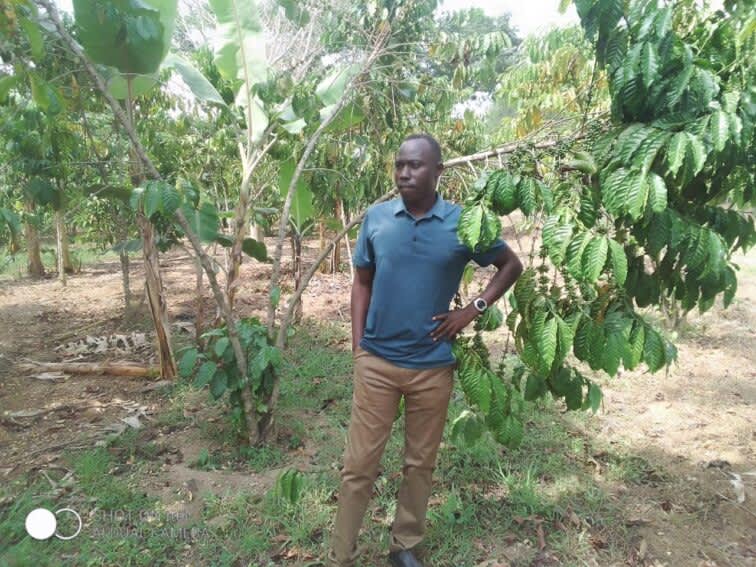
Coffee farmer, buyer and processor Oyet Alfred standing in his 5-acre coffee garden in Pawel-Amuru District
Like Oyet, few other farmers experimented with the crop in the other districts of Acholi sub region – Kitgum, Nwoya and Omoro amongst others. Each of them broadcast one common denominator message – Coffee blooms in the region. Operation wealth creation received and responded to the message by distributing more than 50 million Coffee seedlings over the past three years alone, inspired by the stories of the pioneer farmers.
Oyet is now part of a network of Coffee Farmers in Northern Uganda united under the Acholi Coffee Farmers’ Union. He says the region is hosting some 65 million coffee trees, with nearly 35 million already producing cherries. Rapid gain of traction. Acholi sub region alone is hosting 40 percent of the trees in Northern Uganda.
New Frontier
Government is strategically looking at Northern Uganda as the new frontier of Robusta Coffee, after other parts suffered debilitating attacks by Coffee wilt disease. To produce exceptionally big screens, different coffee grades are being climatically conditioned to be given to farmers from within the climate zone by experts in the National Coffee Research Institute (NACORI).
In Owak Village, Kweyo Parish in Omoro district, a national coffee mother garden has just been established for this purpose. At the beginning of 2026, the garden was stocked with Kituzi Resistant varieties from the first to the tenth grades. The garden sitting on two acres of land is being managed by Kawacom Uganda Limited, a net off taker and exporter of Coffee.
Katusabe Obed is a senior Coffee Technician managing the Nursery bed. “The purpose of the mother garden is to generate healthy planting materials from these parents out of which thousands of improved cuttings will be propagated into seedlings for farmers.” He started while walking between rows of the mother garden.
The initial target is to produce 400,000 cuttings from the mother gardens each year from two sites in Omoro and Gulu districts. The site has been certified by NACORI, the Institute supplying the planting stock and carefully studying its performance in the region.
In the Owak Mother Garden, KR2 was omitted after it succumbed to Coffee wilt disease in Mukono Agro Ecological Zone where it was first produced by NACORI.
“We are sure of the quality because the varieties come directly from the National Coffee Research Institute,” Katusabe explains.
The improved varieties selected for introduction in Northern Uganda are high-yielding and resistant to coffee wilt, giving farmers the much-needed confidence in a new crop variety. Seedlings from the mother gardens will be brooded in Nursery beds for up to seven or eight months before they are distributed to farmers with prepared fields for planting.
Among such tender young trees, flowering and fruiting usually begin in a space of two years, quick enough for poverty battered communities to begin banking profits. Until then, extension is critical for knowledge transfer for proper land preparation, spacing, mulching, irrigation and disease management to be achieved, according to Obed.
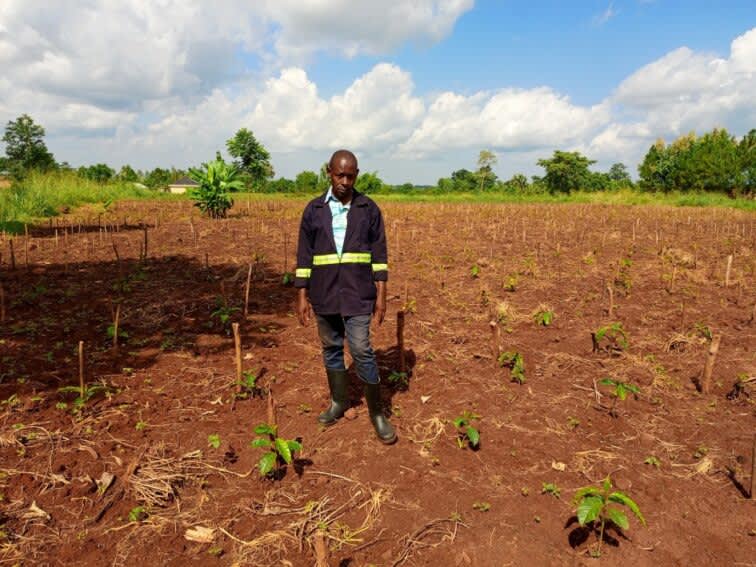
Nursery Manager Katusabe standing in the middle of Kawacom’s Mother Garden in Owak Villege
“A good seedling alone is not enough,” he says, adding that “farmers must follow recommended agronomic practices if they want good yields.”
Uganda is dreaming of joining the League of World’s leading Coffee producers in the next few years by expanding its net production threshold to about 60 million bags of Coffee a year, from the current 20 million bags a year. And the goal is not just to export it as raw material but a finished product, consumed both domestically and globally.
As the mother gardens provide a firm foundation for this future, satellite nurseries are being designed and distributed in close proximities to interested farmers throughout Northern Uganda in anticipation of the emerging agroforestry landscape.
Geoffrey Ogen, an Agronomist at Kawacom says the “objectives of setting up nurseries close to farming groups include reducing the net distance traveled by farmers to access quality seeds, training and extension services.”
Since 2013 when the first coffee seedlings arrived in Northern Uganda under Operation Wealth Creation trucks for distribution to farmers, they were purchased from certified nursery bed operators in mid northern and western Uganda. Transportation shock led to high mortality of seedlings as some were supplied out of due seasons.
Farmers will receive seedlings in phased manner in groups of 1,800 farmers every planting season from the Kawacom Nursery Beds. By 2026, more than 2,500 farmers have registered on the waiting list.
Farmers are grateful that trusted seedlings have arrived. They still worry that dependable value chain knowledge and skills could have been left behind in Hoima or Busenyi districts if not with the centrally based NACORI. Who will teach them how to not just farm Coffee but grow coffee as expected?
Kawacom is thinking ahead of them by few steps. Nursery bed operators are being trained and mentored alongside community volunteers who will serve as paraprofessional extension service providers reaching out to farmers on schedule. Pest control must work just like on the farm management.
“So far, 14 nursery operators have been trained in the Acholi sub region alone on propagation of quality seedlings using certified planting materials from the research institute.” According to Ogen. The Ministry of Agriculture, Animal Industry and Fisheries is mentoring another set of 34 nursery operators to complement the private sector efforts.
In the meantime, Coffee seedlings are streaming to farmers for free through different supply chains under a donor-funded project operating in Gulu, Omoro and Kitgum districts and the national Operations Wealth Creation (OWC). The time is coming when farmers will be expected to take full ownership of the enterprise and pay for breeding costs and services.
Signature Taste
Northern Uganda’s Coffee cup carries a signature tropical aromatic taste brewed by the World’s most hospitable hands. Naturally cured to sweetness by the hot sun heats of Northern Uganda, entrepreneurs like Alfred Oyet roast the Coffee in environmentally acceptable ways to the satisfaction of tourists destined to Kidepo Valley National Parks or Murchison Falls National Parks.
From small Cafeterias in the heart of Gulu City to upscale supermarkets and hotels, Northern Uganda’s Coffee cups are the new sensation on the menu. Sip it slow with organic honey from the Shea Nut trees and enjoy the ultimate taste of Northern Uganda.

Value addition allows Alfred to earn significantly more than selling raw coffee-he sells coffee soap, coffee face scrub (in his hand) and other products.
Coffee Economics
A kilogramme of raw coffee sold by a farmer may fetch only Shs6,000 to Shs7,000. The same coffee, after cleaning and roasting, sells for up to Shs55,000, while ground coffee reaches around Shs60,000. Brewed into espresso cups, one kilogramme can generate over Shs1 million in retail sales.
“That is why farmers must not only produce coffee—they must think about processing and markets,” Oyet says.
He believes Northern Uganda should invest more in roasting plants, coffee shops and local brands instead of exporting raw beans.
“The farmer benefits most when value addition happens close to where coffee is produced,” he says.
Inside his office, Alfred Oyet is already thinking beyond farming. He wants Northern Uganda to become recognised internationally for its unique coffee flavour while integrating digital traceability, laboratory testing and even blockchain technology into coffee marketing.
His long-term vision includes a “Smart Coffee City” where coffee quality can be tested, traced and marketed directly to international buyers because of environmental compliance.

Oyet sipping Coffee in his office with sample coffee beans on a white polythene
Alfred believes Northern Uganda possesses unique coffee flavours capable of competing in specialty markets. However, maintaining that reputation depends on quality right from the nursery.
Julius Twiine, the Senior Agriculture Officer overseeing Acholi, Lango and parts of Karamoja, says the government distributed 24 million clonal coffee seedlings across Northern Uganda during the first planting season of 2026 alone.
According to Twiine, “a farmer who starts with half an acre or one acre can eventually earn about UGX 15 million annually if the coffee is well managed.”
Climate Benefits
Beyond fighting household poverty, Coffee offers many environmental benefits to growers. According to Ogen, it is estimated that a mature Coffee plant sequesters between one to two tons of Carbon dioxide a year.
When intercropped with other fast-maturing shade trees like bananas, the plant offers many economic and environment benefits including nourishing soil fertility, reducing emission and mitigating impacts such as soil erosion amongst others.
It is believed nurturing the baby coffee industry will quickly replenish the deforested landscapes of Northern Uganda and offer a sustainable solution to household poverty in the region.