

Hi, I am Anguzu, Radio Pacis AI Assistant. How can I help you today? Ask me about Radio Pacis, our programmes, frequencies, news, Arua, or the world around us.
22 June 2026 · Radio Pacis Newsroom
Pupils of Paicho Primary School showcase a presentation during the Day of the African Child celebrations held at their school. By Proscovia Achomo Leaders in Gulu District have renewed calls for urgent investment in clean water, sanitation, and hygiene (WASH)
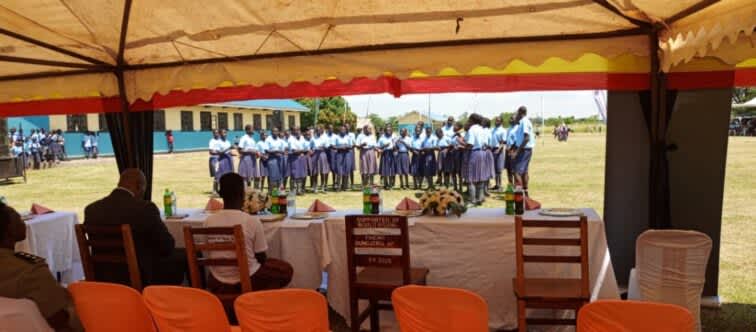
Pupils of Paicho Primary School showcase a presentation during the Day of the African Child celebrations held at their school.
By Proscovia Achomo
Leaders in Gulu District have renewed calls for urgent investment in clean water, sanitation, and hygiene (WASH) services, emphasizing that every child deserves access to safe water and a healthy learning environment.
The call was made during the Day of the African Child celebrations held on 16th June in Paicho Sub- County, Gulu District, under the theme, “Ensuring Access to Water, Sanitation and Hygiene for Every African Child.”
The event brought together Children, district leaders, educators, development partners, and community members to reflect on the challenges children face in accessing basic WASH services and to explore solutions for improving their well-being.
Speaking on behalf of children, Elizabeth Ruth Atim, a pupil of Patiko Prison Primary School and child delegate, delivered an emotional account of the realities faced by many children in rural communities. She explained that long journeys in search of water, broken boreholes, inadequate sanitation facilities, and poor hygiene conditions continue to affect children’s health and education. “At times, I am forced to drink water from streams because there is no clean water available. Many children fall sick, miss classes, and even examinations because of diseases linked to poor sanitation and unsafe water. As children, we have a right to clean water, safe toilets, and a healthy environment,” Atim said.
Representing development partners, Martha Aceng, Administrator of Child Voice Uganda, reaffirmed the commitment of civil society organizations (CSOs) to supporting Gulu District’s efforts to improve children’s access to water, sanitation, and hygiene services.
Aceng highlighted the contributions of several organizations already making a difference in communities and schools. She cited Drop in the Bucket Organization, which has drilled deep wells that are directly benefiting both schools and surrounding communities, significantly improving access to safe drinking water and promoting better hygiene practices among learners.
Providing an update on the WASH situation in schools, Balington Ongwech, Secretary for Works, Production and Technical Services at Gulu District Local Government, revealed that while progress has been made, significant gaps remain in providing adequate facilities for learners.
Ongwech said latrine coverage in schools across Gulu District currently stands at 78 percent, while handwashing facilities remain at 26 percent. He added that school menstrual hygiene management is at 46 percent, while safe water coverage in schools stands at 68 percent.
He explained that the figures demonstrate the need for continued investment and stronger partnerships to improve WASH facilities in schools and ensure children learn in safe and healthy environments. “The statistics show that although we have made progress, there is still more work needed to ensure every child has access to clean water, proper sanitation, and hygiene facilities,” Ongwech said.
The Gulu District Vice Chairperson, Peter Okot, acknowledged that despite ongoing efforts, access to safe drinking water remains a significant challenge in several parts of the district. He noted that delays in the implementation of some water projects have slowed progress and called for greater cooperation among leaders and stakeholders.
“Gulu District is still struggling to provide adequate clean water facilities to communities. Some projects have been delayed because key Memoranda of Understanding have not yet been signed. I call upon all leaders and partners to work together so that these processes are completed and more people can access clean and safe water,” Okot said.
He emphasized that improved water access is critical not only for public health but also for children’s education and overall development.
The Resident District Commissioner (RDC) for Gulu District, John Bosco Tumwesigye, who officiated as the chief guest, reaffirmed the government’s commitment to improving Water, Sanitation and Hygiene services in schools and communities.
Tumwesigye described access to clean water and sanitation as a fundamental right for every child and urged schools to prioritize hygiene standards to protect learners from preventable diseases. “The life of a child is not negotiable. Every child must have access to clean water, safe toilets, and soap for handwashing. Water is life, and government is already investing in WASH programmes. We must ensure that every school provides a safe and healthy environment for children to learn and thrive,” he said.
The Day of the African Child is commemorated every year on June 16 in memory of thousands of students who participated in the 1976 Soweto Uprising in South Africa. The students protested against poor-quality education and the forced use of Afrikaans as a language of instruction under the apartheid regime.
In recognition of their courage and sacrifice, the Day of the African Child was officially established in 1991 by the Organization of African Unity (OAU), now the African Union (AU), as a platform to promote and protect the rights, welfare, and development of children across Africa.