

Hi, I am Anguzu, Radio Pacis AI Assistant. How can I help you today? Ask me about Radio Pacis, our programmes, frequencies, news, Arua, or the world around us.
14 July 2026 · Radio Pacis Newsroom
Minister of State for Primary Health Care, Hon. Dr. Charles Ayume accompanied by Ministry of Health Officials, addressing U.S. delegation and leaders from Arua city and Arua district at Arua Airport on the Ebola Situation in Uganda. By Dramadri Federick Arua C
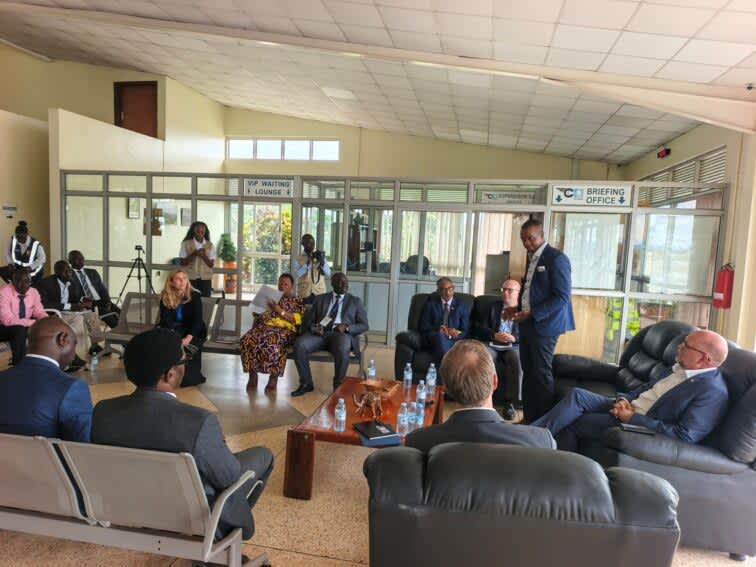
Minister of State for Primary Health Care, Hon. Dr. Charles Ayume accompanied by Ministry of Health Officials, addressing U.S. delegation and leaders from Arua city and Arua district at Arua Airport on the Ebola Situation in Uganda.
By Dramadri Federick
Arua City
The Government of Uganda, through the Ministry of Health, is considering the phased lifting of some restrictions that were introduced to contain the spread of the Bundibugyo Ebola Virus Disease, following several weeks without a confirmed local case.
The announcement was made by the Minister of State for Primary Health Care, Hon. Dr. Charles Ayume, during his welcome remarks at Arua Airport, where he received a United States delegation on a fact-finding mission. The delegation, led by Mikeal Cleverley, the Chargé D’affaires at the U.S. Embassy in Uganda, is assessing Uganda’s Ebola preparedness and response capacity.
Dr. Ayume said the Ministry has resolved to ease some of the public health measures that were enforced at the height of the outbreak. Among the restrictions under consideration for removal are the ban on the operation of nightclubs and limitations affecting bars.
According to the minister, the decision follows sustained surveillance and several months without Uganda recording a new Ebola case. He added that the Ministry of Health is finalizing a circular that will formally communicate the changes, while emphasizing that the public must continue observing Standard Operating Procedures (SOPs).
“We have spoken as the Ministry of Health team that we can now open the bars and the night clubs but it has to be done in a phased manner under strict adherence to the Standard Operating Protocol. The Minister will communicate in a circular. Dr. Ayume announced.
At the peak of the outbreak, Uganda implemented a number of stringent public health measures to prevent the spread of the Bundibugyo Ebola Virus Disease. These included enhanced screening at border points, restrictions on public gatherings, and the temporary closure of some border crossing points and other high-risk public venues.
Arua District Ebola Task Force Chairperson, Gorre Goffin, said the intensified surveillance and close monitoring at points of entry have played a key role in preventing the spread of the disease into the country.
“There’s no positive case even if we run along the body and this is because of the vigilancy and collaboration between health workers, security and the community members”. Gorre explained
The visiting United States delegation is in the West Nile region for a two-day assessment of Ebola preparedness and response at key points of entry, including Arua Airport, Vurra Customs Point of Entry, Arua Regional Referral Hospital, and Imvepi Refugee Settlement.
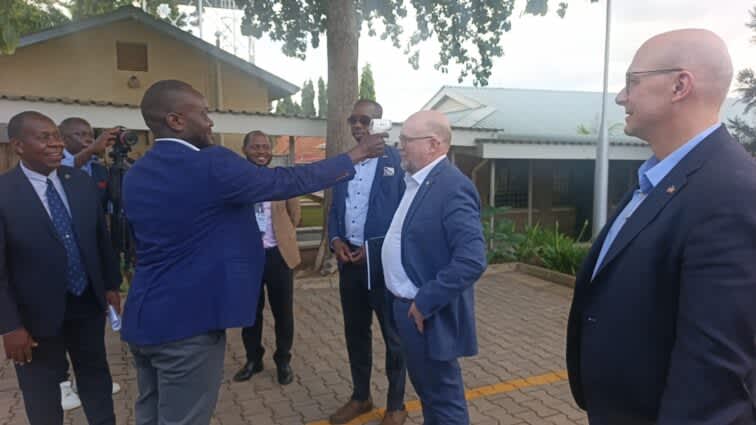
Mikeal Cleverly, the Chargé d’Affaires at the U.S. Embassy in Uganda subjects himself for temperature screening at Uganda Virus Research Institute UVRI regional Laboratory.
Mikeal Cleverley, the Chargé D’affaires at the U.S. Embassy in Uganda, commended the Government of Uganda for its effective response in containing the Ebola outbreak and pledged continued U.S. support in strengthening the country’s capacity to combat Ebola and other disease outbreaks.
“Ugandan Authorities Know what to do from state level, the regional level and at the district levels, they are doing it perfectly”. Cleverley said.
According to a fact sheet released during the visit, the United States has significantly supported Uganda’s Ebola response and broader humanitarian efforts in 2026. The U.S. has contributed more than US$370 million to the regional Ebola response, supporting laboratory systems, disease surveillance and contact tracing, border health screening, emergency operations, infection prevention and control, logistics, community engagement, and technical expertise.
The fact sheet further states that the United States announced US$350 million in Ebola response and humanitarian assistance for Uganda, the Democratic Republic of the Congo, and South Sudan through the United Nations Office for the Coordination of Humanitarian Affairs (OCHA). In addition, US$75 million has been provided specifically to support Uganda’s refugee response and address acute humanitarian needs.
The assistance builds on the long-standing US$2.3 billion U.S.–Uganda Health Memorandum of Understanding, which continues to strengthen Uganda’s public health systems, disease surveillance, and emergency preparedness.
The latest Ministry of Health figures show that Uganda last confirmed an Ebola case on 22 June 2026. The country has recorded a cumulative total of 20 confirmed cases, of which 15 were imported and five resulted from local transmission.
So far, 17 patients have recovered and been discharged, one patient remains under treatment, and two deaths have been recorded in connection with the Bundibugyo Ebola strain.