


Hi, I am Anguzu, Radio Pacis AI Assistant. How can I help you today? Ask me about Radio Pacis, our programmes, frequencies, news, Arua, or the world around us.
15 July 2026 · Radio Pacis Newsroom
Demonstration farm established by one of the beneficiaries who attended the training in Yumbe. Photo by Ganiko Samson Bullen. By Ganiko Samson Bullen Moyo About 37 kilometers northeast of Moyo Town Council, lies Dufile Sub-county, an area where climate change
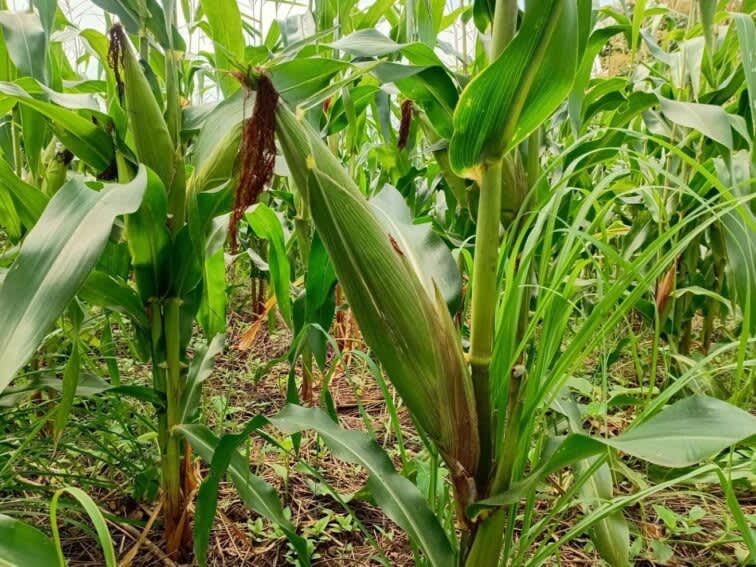
Demonstration farm established by one of the beneficiaries who attended the training in Yumbe. Photo by Ganiko Samson Bullen.
By Ganiko Samson Bullen
Moyo
About 37 kilometers northeast of Moyo Town Council, lies Dufile Sub-county, an area where climate change continues to threaten agricultural production. Temperatures remain high throughout the year, averaging between 30 and 34 degrees Celsius, while during the dry months of January and February, they can soar to between 36 and 40 degrees Celsius.
The prolonged heat has left many crops withering under persistent drought, forcing farmers to seek new and sustainable farming methods. However, amid these challenges, innovation is beginning to transform livelihoods. This feature story provides an understanding of a modern system of farming that looks to be breaking through harsh weather conditions.
At the Dufile Sub-county headquarters stands a demonstration farm established by the Agricultural Officer, Oduti Deogracious, one of the beneficiaries trained by Climate Smart Jobs, an initiative of Palladium UK, under the Pfumvudza Project. Guided by the four principles of conservation agriculture, Deogracious believes the approach offers a practical solution to climate change while improving crop yields.
So far, he has trained 80 farmers, comprising 37 women and 43 men, who are now applying the same farming techniques in their own gardens and passing on the knowledge to other farmers across the sub-county.
DATA VIZ (to be inserted on the website)
<iframe title=”Over 80 Farmers Trained on Climate-Smart Agriculture, "Pfumvudza" Practice Approach Across Moyo District” aria-label=”Column Chart” id=”datawrapper-chart-CbVyi” src=”https://datawrapper.dwcdn.net/CbVyi/1/” scrolling=”no” frameborder=”0″ style=”width: 0; min-width: 100% !important; border: none;” height=”553″ data-external=”1″></iframe><script type=”text/javascript”>(function(){function e(){window.addEventListener(`message`,function(e){if(e.data[`datawrapper-height`]!==void 0){var t=document.querySelectorAll(`iframe`);for(var n in e.data[`datawrapper-height`])for(var r=0,i;i=t[r];r++)if(i.contentWindow===e.source){var a=e.data[`datawrapper-height`][n]+`px`;i.style.height=a}}})}e()})();</script>
When I visited the demonstration farm, Deogracious explained how the skills acquired through the training enabled him to establish a climate-smart farming model that is improving production and helping farmers earn income to support their households.
He says the training came at the right time, providing practical solutions for smallholder farmers who continue to suffer heavy crop losses due to prolonged dry spell.
According to him, the Pfumvudza system is built on four key principles that every farmer should embrace.
“From what I got there, I got inspired because to me it presented the real solutions to our current problems in this area of climate change, small holder farmers could lose a lot of crops, which is the major constraint that they face,” Deogracious disclosed.
He noted that the approach is yielding its fruit as his crops are so healthy compared to other crops, which are not doing well due to long dry spell.
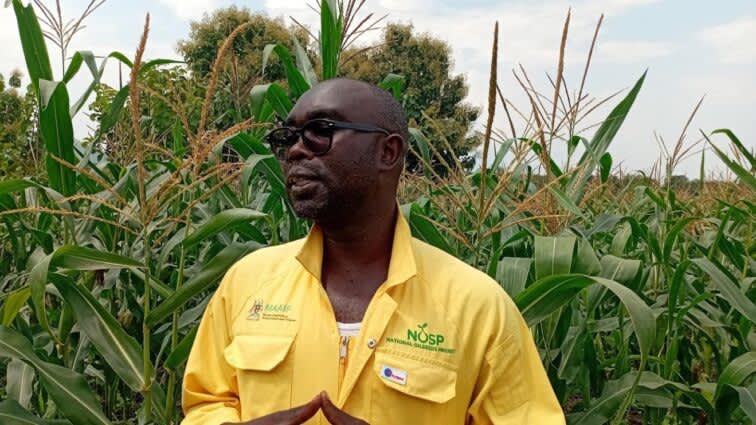
Deogracious the PFUMVUDZA direct beneficiary who has trained about 80 farmers in Dufile Sub County, photo by Ganiko Samson Bullen.
Maize is one of the most important crops in the Madi Sub-region, serving both as a staple food and a source of household income. Across districts such as Moyo, Obongi and Adjumani, thousands of smallholder farmers depend on maize for food security, while many earn an income by selling surplus grain in local markets and across the border to South Sudan.
Beyond consumption, maize supports livestock production through its grain, bran and crop residues, creating additional economic opportunities for farming households. The crop also generates employment along the agricultural value chain, from land preparation and planting to harvesting, transportation and marketing.
However, maize production in the sub-region has increasingly been affected by prolonged dry spells and unpredictable rainfall caused by climate change. As a result, climate-smart farming approaches such as the Pfumvudza Model are helping farmers improve soil moisture retention, increase yields and build resilience against harsh weather conditions.
For many farming communities in the Madi Sub-region, maize remains more than just a crop—it is a foundation for food security, income generation and sustainable rural livelihoods.
Although maize is the most common crop promoted under the Pfumvudza Model, the conservation agriculture approach can also be used to grow a wide range of food and cash crops. These include beans, groundnuts, soybeans, sorghum, millet, cassava, sweet potatoes, cowpeas, sesame (simsim), sunflower and a variety of vegetables such as tomatoes, onions, cabbages and eggplants.
The model emphasizes minimum soil disturbance, permanent soil cover through mulching and crop rotation or intercropping. These practices help conserve soil moisture, improve soil fertility and reduce erosion, making it suitable for areas experiencing prolonged dry spells and erratic rainfall.
Deogracious then led our reporter to another section of his farm, located next to an unfinished house under construction. There, he has also established a Pfumvudza demonstration plot where he has intercropped maize with groundnuts.
He says the harvest from the garden will not only enable him to complete his house but will also inspire more farmers in the community to adopt climate-smart agriculture as a sustainable source of income.
“What I am borrowing from the Pfumvudza project is mainly about efficiency of resource unitization, with this, I have decided to establish a Pfumvudza farm in one of my plots. Every spot on this plot is being utilized and I believe the money I get from here will help me complete my unfinished building,” Deo disclosed. –
Video to be inserted code; https://drive.google.com/file/d/18J-f_inA8hAh-T8Fq30lkHH7TWonR4ya/view?usp=drive_link
one of the beneficiaries, Ondoga Michael Drabua, says the training has already transformed his farming practices and motivated him to share the knowledge with other farmers.
“Since I got the training, I have spread out the information of the training at the grassroots because I don’t want to keep the skills and the knowledge for myself,” Ondoga stressed.
He explains that, besides implementing the techniques on his own farm, he has helped organize farmer groups to ensure more people benefit from the innovation.
“Where am I coming, there are about 7 farmer groups, engaging them in this approach,” he pointed out
According to Michael, one of the groups comprises 35 members, including 22 men and 13 women, all committed to practicing the Pfumvudza farming model.
Another beneficiary, Draga Remijo from Pajakiri South, says the training completely changed his understanding of maize production. He explains that farmers learned modern conservation practices, including slashing and spraying instead of relying solely on traditional digging.
“The knowledge has greatly improved our confidence, and my farmer group now has 31 members, comprising 23 women and 8 men, including young people who are actively embracing climate-smart agriculture,” he said
DATA VIZ (to be inserted on the website)
Embed code: <iframe title=”74% Women and 26% Men Smallholder Farmers were trained on Climate-Smart Agriculture in Pajakiri Village, Dufile Sub-county, Moyo District, Orokondra Farmers’ Group Enterprise in May, 2026″ aria-label=”Pie Chart” id=”datawrapper-chart-65vxP” src=”https://datawrapper.dwcdn.net/65vxP/2/” scrolling=”no” frameborder=”0″ style=”width: 0; min-width: 100% !important; border: none;” height=”601″ data-external=”1″></iframe><script type=”text/javascript”>(function(){function e(){window.addEventListener(`message`,function(e){if(e.data[`datawrapper-height`]!==void 0){var t=document.querySelectorAll(`iframe`);for(var n in e.data[`datawrapper-height`])for(var r=0,i;i=t[r];r++)if(i.contentWindow===e.source){var a=e.data[`datawrapper-height`][n]+`px`;i.style.height=a}}})}e()})();</script>
The Parish Chief of Dufile Sub-county, Malilamugu Edward, says the Pfumvudza Model has already made a visible impact on agricultural production within the sub-county.
He notes that the demonstration farm has trained 80 farmers, and local leaders are now looking forward to expanding the model to grassroots communities so that beneficiaries of the Parish Development Model (PDM) can also adopt the conservation agriculture skills.
“The demonstration here the day it was started to some of us it was impossible because what was done looked to us has it was a kind of joke but now it’s today that we have come to realize that better things be achieved through this kind of innovation, as a sub county we are looking forward to see that this demonstration is scaled up to the grass root level at parish level” He stated
He noted that the reason for scaling up to the parish level is because of the bigger government program, which is PDM, for the farmers to benefit.
“In my four years of service here have seen a big problem of food facing our community,” he said.
According to Climate Smart Jobs, Maize offers the highest potential grain yields per unit of land when managed correctly, directly translating to household food self-sufficiency for the year.
An average Pfumvudza Maize Plot requires the following inputs to produce an average 50 Kilograms of grains.
– Mark field at standard 16M x 39 M
– Space 15Cm x 15Cm x 15Cm.
– Dig 52 holes at 28 holes per row
– Inter row spacing of 75 Cm
– In-row spacing of 60 Cm.
– 2 Kilograms of seed
– 12 kilograms of lime
– 16 kilograms of DAP basal fertilizer
– 16 Kilograms of Urea to dressing fertilizer
– Insecticides for stalk borer and Fall Armyworm.