


Hi, I am Anguzu, Radio Pacis AI Assistant. How can I help you today? Ask me about Radio Pacis, our programmes, frequencies, news, Arua, or the world around us.
19 May 2026 · Radio Pacis Newsroom
Residence of Holy Rosary Cell, Laroo-Pece Division receiving free medical screening during a malaria prevention medical camp By Biko Rombe Gulu City The public has been urged to avoid self-medication due to the serious health risks associated with the practice
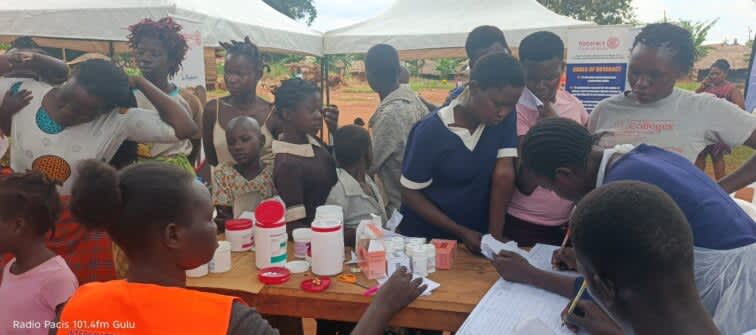
Residence of Holy Rosary Cell, Laroo-Pece Division receiving free medical screening during a malaria prevention medical camp
By Biko Rombe
Gulu City
The public has been urged to avoid self-medication due to the serious health risks associated with the practice, particularly in the treatment of malaria.
Health officials and development partners say the habit continues to undermine proper diagnosis and contributes to drug resistance and ineffective treatment outcomes.
Speaking during a recent malaria prevention campaign, Ogena Thomas Opiyo, the Project Chairperson of the Rotaract Club of Gulu University, cautioned the public against taking malaria medication based on suspicion alone.
He noted that self-medication makes it difficult for health workers to accurately detect and properly treat malaria cases, warning that it poses a major public health risk.
Opiyo emphasized that individuals should always undergo proper medical testing before starting treatment, adding that misuse of malaria drugs can lead to drug resistance, a situation where medicines become less effective even when malaria is later confirmed.
He stressed that malaria control and possible eradication can only be achieved if communities adhere to proper medical guidance and work closely with health professionals.
Similar concerns were raised by Too-ping Geoffrey Nyute, Senior Health Educator with Gulu City Council, who reaffirmed the Ministry of Health policy requiring confirmatory testing before malaria treatment is administered.
Speaking during the World Malaria Day handover of a microscope donated by the Rotaract Club of Gulu University to Laroo Health Centre III, Nyute said health workers are expected to rely on diagnostic tools such as microscopes rather than symptoms alone when diagnosing malaria.
He explained that treating patients without laboratory confirmation leads to inaccurate diagnosis and inappropriate use of medicines, which ultimately weakens treatment effectiveness and undermines national health guidelines.
According to him, adherence to testing protocols ensures more accurate diagnosis, better patient care, and improved use of available medicines.
Concerns over increasing cases of self-medication were also echoed by Patrick Ogwang, the Malaria Focal Person for Gulu City, who highlighted that many people still purchase malaria drugs directly from pharmacies without first seeking medical tests.
He said this practice not only leads to misuse of medication but also contributes to poor treatment outcomes and challenges in malaria control efforts.
Ogwang called for increased access to diagnostic equipment in health facilities to ensure that all suspected cases are properly tested before treatment is given, noting that this would improve the rational use of medicines supplied through the National Medical Stores.
The World Health Organization (WHO) has also warned against self-medication, noting that it can result in incorrect self-diagnosis, harmful drug interactions, and the masking of serious underlying illnesses.
The organization further cautions that improper dosages and unsupervised use of medicines can cause severe side effects, including organ damage such as liver complications, and may also lead to dependency and addiction, particularly when antibiotics or sedatives are misused.
Health experts continue to urge the public to prioritize proper medical consultation and testing, saying this remains a key step in ensuring safe, effective, and responsible malaria treatment.